 |
|
At a time when the United States and Europe still hadn't made up their minds about whether to concentrate their energies on the moon or Mars, Japan had already decided to focus on lunar exploration and utilization.
Courtesy of JAXA
|
| |
Tokyo, Japan - August 27, 2010
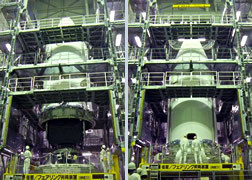
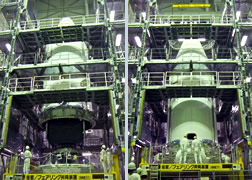
MICHIBIKI encapsulated in the fairing
On August 26, the
first quasi-zenith satellite "MICHIBIKI" was encapsulated in the fairing at the
Spacecraft and Fairing Assembly Building (SFA) at the
Tanegashima Space Center (TNSC.)
The fairing covers the payload to protect it from air resistance, friction heat, and acoustic vibrations during launch.
The fairing for this launch is
4S-type, which is 4 meters in diameter, and 12 meters in height.
 |
|
On August 26, the first quasi-zenith satellite "MICHIBIKI" was encapsulated in the fairing at the Spacecraft and Fairing Assembly Building (SFA) at the Tanegashima Space Center (TNSC.)
Courtesy of JAXA
|
| |
The encapsulated payload will be transported to the
Vehicle Assembly Building and loaded on to the
H-IIA Launch Vehicle No. 18.
Overview of the First Quasi-Zenith Satellite “MICHIBIKI”
System (QZSS) Watching Japan from above
Quasi-Zenith Satellite As mobile phones equipped with
car navigation or
GPS (GPS is a Global Positioning System, which is a positioning system comprised of about 30 GPS satellites. The system was developed by the U.S.) have become widespread, positioning information using satellites is imperative to our lives.
 |
|
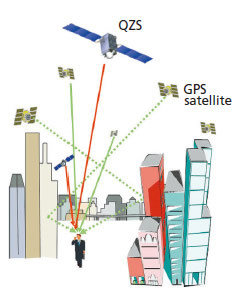
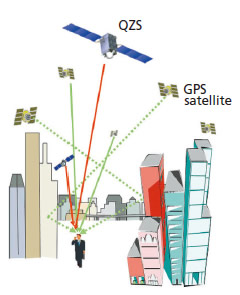
System (QZSS) Watching Japan from above.
Courtesy of JAXA
|
| |
However, in some urban or mountainous areas, positioning signals from a satellite are often hampered by skyscrapers or mountains, or significant errors are caused by reflection waves, thus we sometimes lose our way.
The
first Quasi-Zenith Satellite "MICHIBIKI" will contribute to solving such problems.
The QZSS consists of a multiple number of satellites that fly in the orbit passing through the zenith (just above)
over Japan.
With this system, at least one of the satellites is deployed over Japan permanently.
By placing the satellite always at the near zenith of Japan to additionally provide signals from the
QZSS, we can expand the areas and time duration of the positioning service provision in mountainous and urban regions where radio waves from a
GPS satellite cannot find the necessary number of satellites for positioning (For positioning, it is necessary to receive positioning signals from four or more satellites).
The MICHIBIKI is the first satellite of the
Quasi-Zenith Satellite System to carry out verification for technological aspects and utilization in order to complement and reinforce the
GPS.
You can receive accurate positioning information anywhere in Japan
In places such as urban valleys and mountainous areas where the number of communicable satellites is limited, we will be able to receive more accurate positioning information by combining the
GPS and the
MICHIBIKI.
In addition, the quasi-zenith positioning satellite is to transmit information that can improve accuracy and reliability of the
GPS (A research and development agency affiliated to the Ministry of Land, Infrastructure, Transport and Tourism of Japan engages in R&D of information transmission for improving accuracy and reliability of the GPS).
'Freshness' is critical for mapping
On May 30, 2007, the
Basic Act on the Advancement of Utilizing Geospatial Information was enacted.
It stipulates to make basic map information electronic and standardized for promoting practical use and application of the
geospatial information service (GIS.)
Due to the prevalent use of
car navigation systems, "
freshness" is critical for map information.
If a quasi-zenith positioning satellite can expand the areas and time of the positioning service, it is expected to improve land survey and mapping accuracy with more frequently updated information.
Such
"fresh" map information will be useful for further expanding positioning services.
Helpful in preventing crimes and traffic accidents
Availability and reliability are major challenges we face when we try to apply satellite positioning to fields that entail strict safety requirements (Temporal ratio for acquiring signals from at least four satellites that are required for positioning, or for achieving designated positioning accuracy).
A quasi-zenith positioning satellite plays an important role to encourage technological development that is applicable for enhancing the availability and reliability of the
GPS.
If we can overcome these challenges, satellite positioning will be more utilized in various areas including application for the Intelligent Transport Systems (ITS), tracking stolen cars, and preventing illegal waste disposal.
Contribute to upgrading work efficiency in the agriculture, fishery, and construction fields
Satellite positioning technology is also applied to control construction and agricultural machinery.
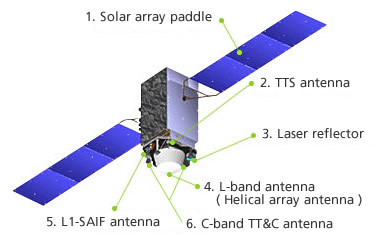 |
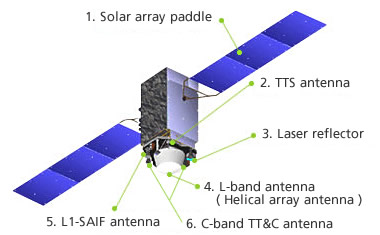
Configuration and onboard parts of MICHIBIKI.
Courtesy of JAXA |
| |
If a highly accurate positioning service is available all over Japan, it can be useful for the agriculture and fishery industries as well as for saving energy and improving work efficiency of construction work in mountainous areas.
Configuration and onboard parts of MICHIBIKI
1. Solar Array Paddle
To transform sunlight to electric power to provide energy necessary for the satellite.
2. TTS Antenna
A transmission/receiving antenna for calibration tests on the onboard clock to conduct bidirectional time comparison with the ground.
3. Laser Reflector
To carry out laser ranging for verifying orbit and clock estimations and model improvements using L-band ranging signals.
4. L-band Antenna (Helical Array Antenna)
Transmitting five positioning signals including satellite position and time on four frequency bandwidths.
5. L1-SAIF Antenna
An antenna for reinforcing positioning signals to realize positioning accuracy of one meter.
6. C-band TT&C Antenna
Receiving correction data from the Okinawa tracking and communication station. It will also be used for transmitting and receiving signals for controlling the satellite.
Major Characteristics
Shape
2 box shape with wing-type solar array paddles
2.9m in depth x 3.1m in width x 6.2m in height
(Length between the tips of the paddles: 25.3 m)
Weight
Approx. 4000kg
Orbiter
Quasi-Zenith Orbit
Altitude
Apogee: approx. 32,000 km, Perigee: approx. 40,000 km
Inclination
Approx. 40 degrees (Fluctuating between 39 and 47 degrees; 41 degrees in the initial phase.)
Period
23 hours 56 minutes
http://www.jaxa.jp/countdown/f18/overview/michibiki_e.html
August 20, 2010 (JST)
Greenhouse gases Observing SATellite (GOSAT)
The Third Research Announcement
Japan Aerospace Exploration Agency (JAXA)
National Institute for Environment Studies (NIES)
Ministry of the Environment (MOE)
The Japan Aerospace Exploration Agency (JAXA), the
National Institute for Environmental Studies (NIES), and the
Ministry of the Environment (MOE) (hereafter referred to as the "
Three Parties" collectively) are jointly promoting the
Greenhouse Gases Observing Satellite "IBUKI" (GOSAT) Project.
The spacecraft was launched successfully on January 23, 2009, and has been operating properly since then.
The GOSAT observational data and its processed products are released to the public.
The Three Parties would like to accept research proposals for the third time for the purpose of facilitating the data quality evaluation, including calibration, validation, and the utilization of the
GOSAT data.
 |
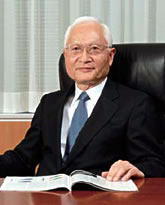
Dr. Keiji Tachikawa, President of JAXA.
Courtesy of JAXA |
| |
As appeared in the first and the
second Research Announcement (RA), which adopted 88 research proposals in total, the
Three Parties would like to accept research proposals in any of the following five specific topics also in the
third RA:
1) Calibration,
2) Data processing algorithm,
3) Carbon balance estimation / Atmospheric transport modeling,
4) Validation,
5) Data application.
This announcement will be open to international science and technology community. Individual investigators of any nationality and researchers of any organization, including educational, governmental, and private institutions, are encouraged to apply.
Proposals must be for non-profit and peace purposes and should be prepared either in
Japanese or
English.
All submitted proposals are to be evaluated by the
RA Selection and Evaluation Committee for the Three Parties.
The Three Parties will hold a workshop sometime in the first half of the next year for principle investigators of the selected research proposals.
Please read the following documents and apply for the
third RA by emailing the application form to the
GOSAT RA Office () by October 29, 2010.
Your application will be greatly appreciated.
For further detail, please visit the following URL.
(Japanese)
http://www.gosat.nies.go.jp/jp/proposal/advertise.htm
(English)
http://www.gosat.nies.go.jp/eng/proposal/advertise.htm
 |
| Courtesy of JAXA |
| |
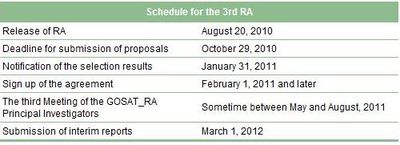
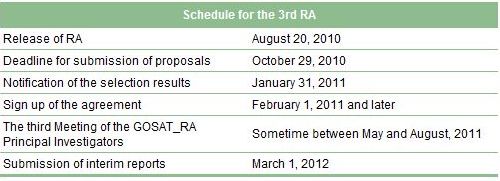
Schedule for the 3rd RA
- Release of RA August 20, 2010
- Deadline for submission of proposals October 29, 2010
- Notification of the selection results January 31, 2011
http://www.jaxa.jp/press/2010/08/20100820_ibuki_e.html
About JAXA
On October 1, 2003, the
Institute of Space and Astronautical Science (ISAS), the
National Aerospace Laboratory of Japan (NAL) and the
National Space Development Agency of Japan (NASDA) were merged into one independent administrative institution to be able to perform all their activities in the aerospace field as one organization, from basic research and development to utilization.
The independent administrative institution is the
Japan Aerospace Exploration Agency (JAXA.)
As space development and utilization, and aviation research and development are steps to achieve the nation's policy objectives, our contribution to problem solving is an important mission for us.
JAXA proposed its long-term vision, "
JAXA2025," to realize our own mission.
 |
|
Courtesy of JAXA
|
| |
Under our corporate message "
Reaching for the skies, exploring space,"
JAXA is pursuing great possibilities in various aerospace fields and is striving to succeed with various research and development missions in order to contribute to the peace and happiness of humankind.
http://www.jaxa.jp/about/index_e.html
For the Aerospace of Tomorrow – JAXA 2025
Dr. Keiji Tachikawa
President, Japan Aerospace Exploration Agency (JAXA)
We have narrowed down the objectives articulated in the
Vision.
As far as space is concerned, we'll focus mainly on three areas: expansion of space utilization, further development of space science, and space access technology.
I don't think that this is too ambitious.
 |
Dr. Keiji Tachikawa, President of JAXA.
Courtesy of JAXA |
| |
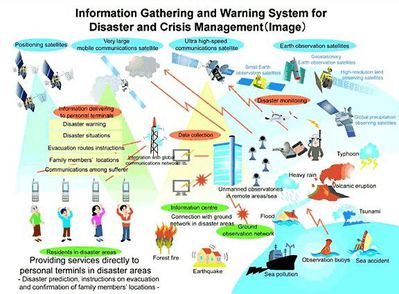
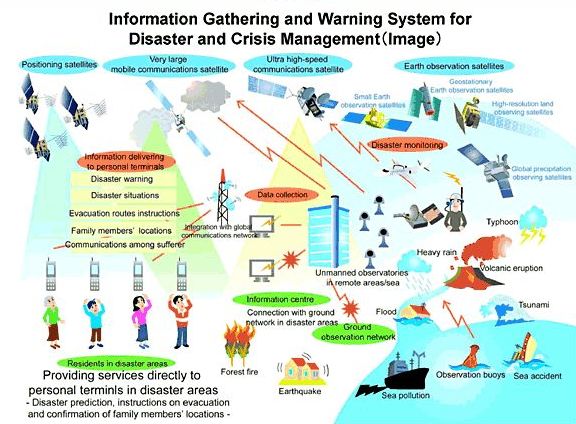
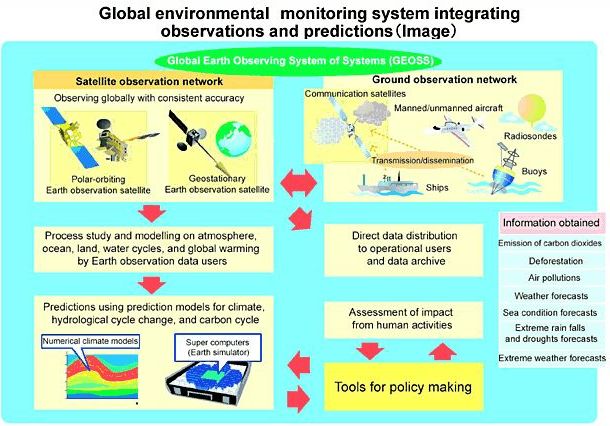
Regarding expansion of space utilization, apart from communications, broadcasting and weather forecasting, which have already been established, we want to focus on other, undeveloped areas, such as the imminent matters of natural disaster management and environmental issues.
 |
|
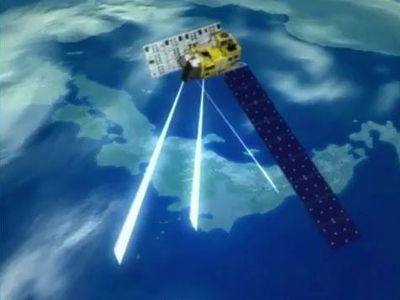
Global environmental monitoring system.
Courtesy of JAXA
|
| |
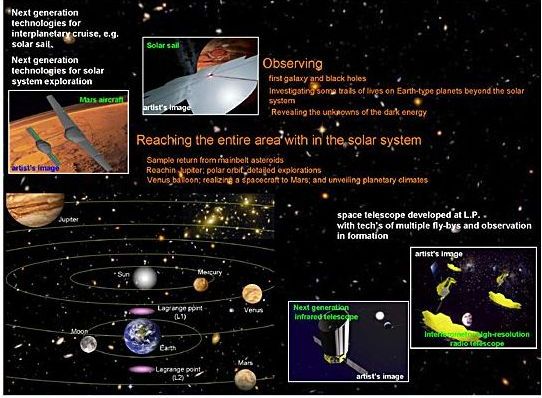
We have also selectively narrowed down the targets for space science. We are going to focus on areas that have been widely recognized, such as X-ray astronomy and infrared astronomy.
Apart from astronomy, there is also solar system exploration, concentrating on the inner planets, which are essential to solving the mystery of Earth's origin.
We are also looking at deep space exploration.
 |
|
Information-gathering and warning system for disaster and crisis management.
Courtesy of JAXA
|
| |
At a time when the
United States and Europe still hadn't made up their minds about whether to concentrate their energies on the
moon or Mars, Japan had already decided to focus on lunar exploration and utilization.
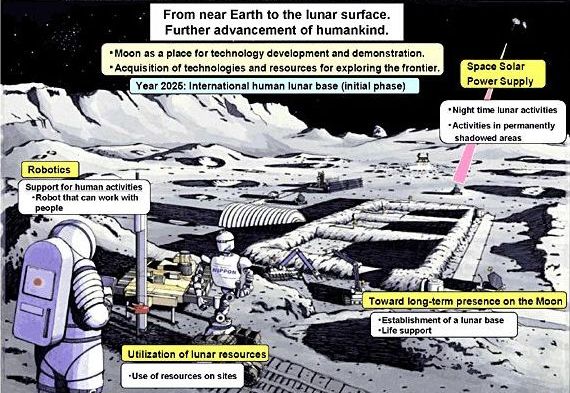
Lunar utilization consists of three main pillars.
The first one involves establishing a stable base on the moon to enable permanent lunar exploration and the construction of an astronomical observatory there.
The second pillar involves utilizing lunar resources.
If we can discover resources other than helium-3, which has already been found, we'll be able to use those resources effectively.
And
the third pillar involves attempting to turn the moon into a base for missions to other planets.
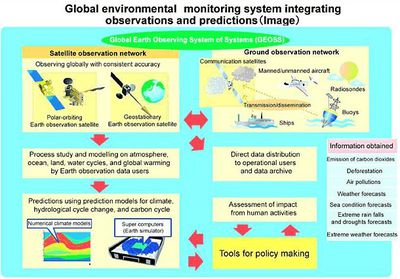 |
|
Global environmental monitoring system integrating observations and predictions.
Courtesy of JAXA
|
| |
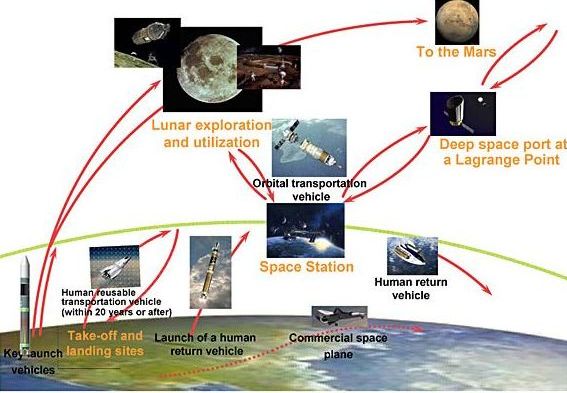
Naturally, it will be impossible to conduct space activities just with robots, and we'll need human bodies.
That means that we need to develop human space access, while increasing the reliability of robots.
This is what space access technology entails.
I'm not being unrealistic in talking about this here.
The JAXA Vision is not to be realized 20 years from now, but within the next 20 years.
So not everything is expected to happen in the
year of 2025.
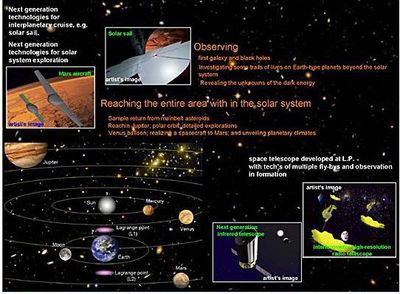 |
Future space observation and solar system exploration.
Courtesy of JAXA |
| |
If there are things that we can do without waiting for 20 years, we won't hesitate.
For instance, we'd like to see space utilization, especially for disaster management, surge forward as quickly as possible, at least within 10 years.
However, we'll attempt to cover not only Japan, but also eventually the entire region of Asia, and as such, we're estimating that it'll take approximately 20 years until we complete the system.
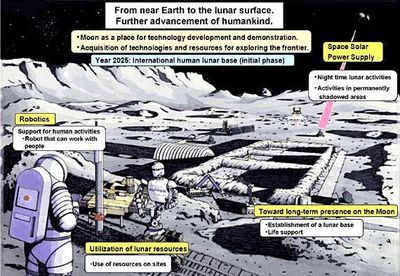 |
|
Future lunar exploration and utilization activities.
Courtesy of JAXA
|
| |
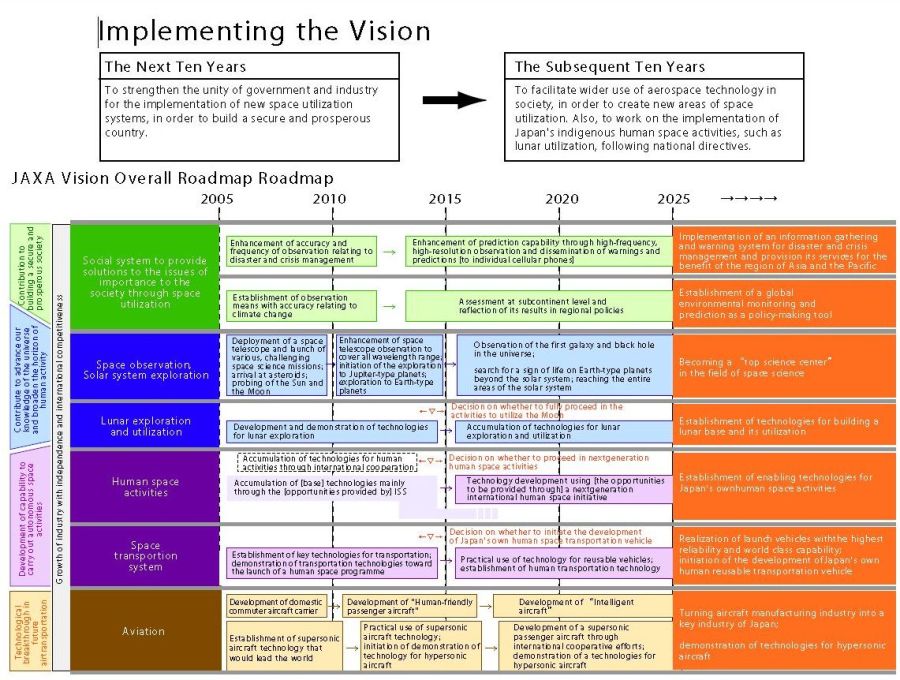
The traditional procedure for deciding on Japan's space policy is that the
Space Activities Commission (SAC), a subsidiary of the
Ministry of Education, Culture, Sport, Science and Technology (MEXT), first articulates a
10-year plan for the government's guidance.
JAXA then refines it to an interim five-year plan, and initiates the plan, after budgeting for each fiscal year.
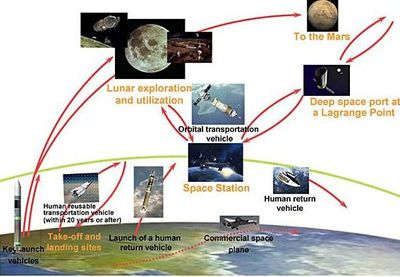 |
|
Future space transportation system.
Courtesy of JAXA
|
| |
As the only space agency in
Japan, JAXA monitors the progress of other foreign space agencies, such as
NASA and
ESA.
This awareness of what is happening globally helps to determine
Japan's research, development and implementation goals.
We're revising the current five-year plan (2003 to 2007) according to the
Vision.
SAC will release the next 10-year plan in 2008, and I'm hoping
JAXA Vision 2025 will help determine
Japan's national space policy.
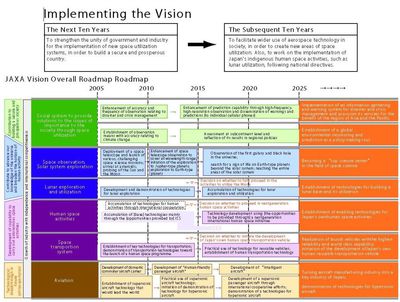 |
|
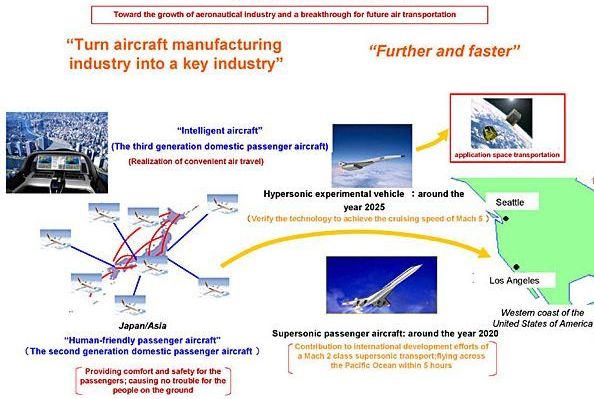
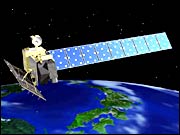
JAXA Vision: the overall roadmap.
Courtesy of JAXA
|
| |
To make the
aerospace industry Japan's key industry, we must develop human resources. We included the issue of aerospace industrialization in the
Vision, because from the perspective of
Japan's current economic circumstances, we're worried that otherwise the industry may not exist in the future.
In big countries such as the
United States and
Russia, aerospace can survive as an independent industry.
In
Europe, however, it's impossible to sustain the industry within one country, so the
ESA (European Space Agency) has been formed, which is backed up by the
European Union.
In terms of size, we can't say that
Japan is really promising.
To keep the aerospace industry alive, we must try to stop the decline.
 |
|
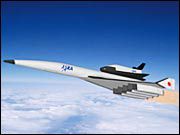
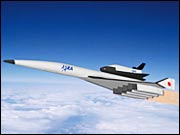
JAXA is studying a pre-cooled turbo engine to use in hypersonic aircraft. The image shows a two-stage-to-orbit (TSTO) fully reusable space plane, with the first stage body installed with its engine.
Courtesy of JAXA
|
| |
To do so, it's estimated that at least 30 billion yen will be necessary.
But realistically, that figure won't be enough to create private-sector competition in the manufacturing of launch vehicles or satellites.
The United States is actually the only country in the world that is making a profit from the space industry, and that is because their defense industry is part of it.
Meanwhile,
Japan ought to establish the industry only for the purposes of peaceful exploitation.
Of all the major countries in the world,
Japan is said to be behind in developing aerospace as a national strategy.
Aerospace is a promising industry.
Why should we miss this chance?
We at
JAXA believe that the aerospace industry should be enhanced as a national policy.
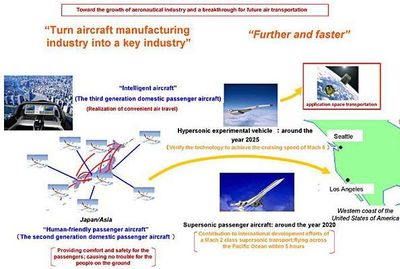 |
|
The Future of Aerospace.
Courtesy of JAXA
|
| |
According to
CSTP (Council for Science and Technology Policy), where decisions on national strategies for
Japan's science and technology are made, aerospace is categorized under
Frontier.
However, in my opinion, aerospace is no longer a "
frontier" in terms of a theory of industrialization.
Rather, it's one of Japan's key technologies; it just hasn't been established as a "
business" yet.
In order to grow and establish the aerospace industry, facilitation and expansion of space utilization are essential.
An industry can operate autonomously only when it has customers who pay money, but it will take some more time for the field of aerospace to reach that stage.
Until business needs are defined and users are established, there is no choice other than spending the nation's tax funds.
It's
JAXA's mission to ask the citizens for their understanding about these circumstances.
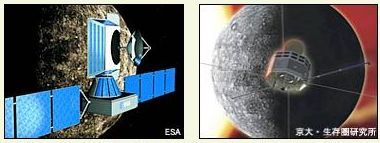 |
|
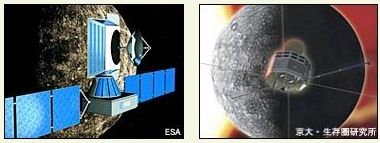
The Mercury exploration mission BepiColombo is a collaborative project between Japan and the European Space Agency (ESA). This project consists of two orbital vehicles: ESA's Mercury Planetary Orbiter (MPO, left) and Japan's Mercury Magnetospheric Orbiter (MMO, right).
Courtesy of JAXA
|
| |
Meanwhile, the aviation industry has already been established as a private industry.
Japan and
France are currently collaborating to develop
supersonic aircraft that can cross the
Pacific Ocean within five hours at a cruising speed of
Mach 2.
JAXA has test facilities, so we'll assist them with research as much as we can.
At the same time,
JAXA is working on technology development for
Mach 5 class hypersonic aircraft, which will be difficult for private companies to do by themselves.
The current
12-hour flight between Japan and Europe is too long and inconvenient, so we're very excited about this project.
We have received tremendous response since we announced the
Vision, and the
Vision emphasizes
International collaboration.
Even if a project is beyond one country's capability, since space is such a large-scale field, the benefit can be shared globally, and therefore, international collaboration is very significant.
Even the
United States recognizes its importance, encouraging such collaboration in their vision published last year.
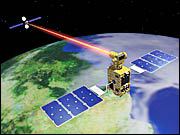 |
|
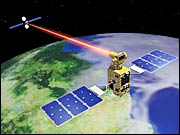
OICETS (Optical Inter-orbit Communication Engineering Test Satellite) enables communications between satellites via optical links.
Courtesy of JAXA
|
| |
In the field of science, countries have been collaborating across borders for a long time.
For instance, a Japanese rocket has launched a satellite equipped with a
made-in-America sensor.
Inversely, an observation device that was developed by
Japan has been launched on an
American satellite.
If not for international collaboration, the
Mercury exploration project BepiColombo and the
OICETS (Optical Inter-orbit Communication Engineering Test Satellite) project would absolutely not be possible.
However, the area of space exploitation appears to be lagging in taking advantage of international collaboration.
I get the impression that each country is still focusing only on its own benefit.
Our
Vision emphasizes international collaboration, especially for the area of space utilization.
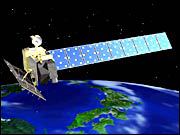 |
|
Advanced Land Observing Satellite (ALOS) is one of the largest Earth observation satellites in the world. Its sensors enable precise land coverage observation. It will be used in the mitigation of environmental destruction and natural disasters, and great international contributions are anticipated.
Courtesy of JAXA
|
| |
As satellites also monitor the other side of the globe, such as
Europe and the
United States, I'd like them to make good use of the data as well.
Our priority will be to come up with the best way to process the data gathered in
Japan and other
Asian countries.
Asia is a region of many natural disasters, so how accurately we can monitor the different land surfaces and make predictions will be key.
For instance, we could raise the alarm on the occurrence of a
tsunami.
There will be a need for many new satellites to enable us to accommodate any type of disaster.
It's difficult to prevent natural disasters, so it's essential to establish a system that can control information distribution for natural disaster predictions, and for disasters that have already occurred, as smoothly and quickly as possible.
This year,
Japan's ALOS (Advanced Land Observing Satellite) is scheduled to be launched.
JAXA has joined the
International Disaster Charter to contribute
ALOS's disaster observations.
Recently, Italy, which also experiences many earthquakes, contacted us, and we have agreed to work together to acquire information about earthquakes from space.
Many countries have great interest in disaster management, so it's extremely important to initiate projects in this area, as smoother international collaboration can be expected.
The Vision has been well received abroad and has also inspired those, such as Europe and Russia, who haven't articulated their own long-term vision.
Apparently,
Russia is hoping to announce its vision in the near future.
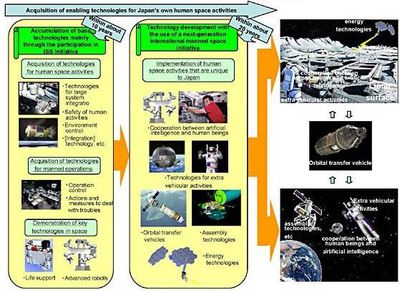 |
|
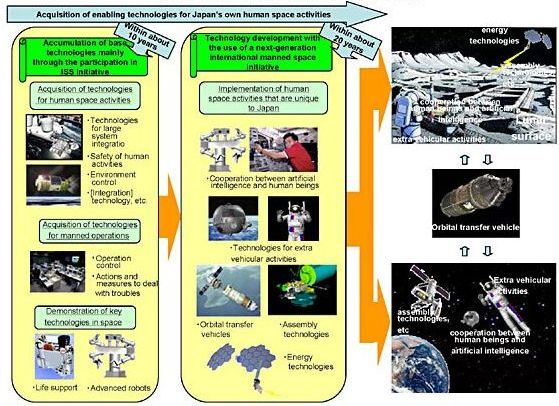
Future human space activities.
Courtesy of JAXA
|
| |
The capabilities of Japan's rocket technology hadn't allowed us to look at the possibility of sending humans into space.
As the country rarely even launched a rocket, many believed that Japan was too small a nation to try such an ambitious project.
That's why the government had decided not to look into the field for the time being.
However, things have changed.
Japan's launch vehicle technology has rapidly advanced, and its reliability has risen up to 95%, as high as that of the
United States and
Russia.
Japan was also inspired by
China's successful manned space flight in 2003.
Having said that, there is no shortcut to human space activity.
To make preparations for the future,
CSTP revised the nation's policy to initiate research.
This is a big step.
The next question is,
when can we see our own human space activity?
I think we'll be able to make a decision as launch vehicle technology steadily increases in reliability.
Within the
next 20 years, human space activity will be necessary, as there are obviously limits to the use of robots, and human cooperation will be necessary for lunar exploration. We'll definitely need to have the capabilities by then.
As long as the reliability of launch vehicles improves within the next 10 years, we see the possibility of developing our own human space activity, so we'll start research during this period.
The decision to launch or not will be made on a national level, so for now we've given ourselves a specific deadline of 10 years.
In the subsequent
10 years, if we still see the potential -- taking into account
Japan's technological strength, the state of its economy, and human resources -- we'll move forward toward 2025.
The project will be quite practical and substantial.
If human space activity technology is established, it will eventually enable space travel.
But this should follow from the success of human space activity, rather than being a project initiated by the
government.
Instead, the
government should focus on demonstrating improvements in the reliability of launch vehicles, since this is a
fundamental requirement for human space activity.
Japan has made efforts to catch up with world-standard technologies.
To do so, it has
developed new launch vehicle after new launch vehicle in a very short timeframe.
And we're finally in a position to surpass world standards. Instead of working on the development of
new rockets, it's now time to think of how to mature our launch-vehicle technology.
Since the merger, this is
JAXA's first vision statement, as articulated by the three institutions involved:
NASDA (National Space Development Agency), NAL (National Aerospace Laboratory), and
ISAS (Institute of Space and Astronautical Science).
The objective behind the
Vision was to summarize the internal views, as well as to get recognition from space specialists and external experts.
In fact,
NASDA had documented its
Vision, but it never went beyond the agency.
We realized that, as long as our
Vision was kept as a purely internal document, we wouldn't be able to earn the nation's support.
So this time, we worked on making the
Vision under the tight supervision of
25 external commissioners.
We're going to share the
Vision both internally and externally this time, promoting it widely, and we'd like to implement the
Vision as public opinion lines up behind it.
Beyond the benefits of communications, broadcasting and weather forecasting, space technology has become an indispensable part of our lives.
How is space technology going to be utilized from now on?
How are our lives going to become more convenient?
We wanted to answer these types of questions in the
JAXA Vision.
We'd like to hear from the public about the
Vision - and not necessarily just from people who are involved in the area of space.
We are also looking forward to hearing general comments and questions.
In one way or another, everyone makes use of the benefits of communications, broadcasting and weather satellites in their daily lives, but not many are aware that these benefits are born of the fruits of space technology development.
And we believe that the general public may have a unique point of view that is not found among specialists.
http://www.jaxa.jp/about/2025/p5_e.html
Dr. Keiji Tachikawa
President of JAXA
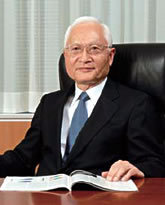 |
|
Dr. Keiji Tachikawa
Courtesy of JAXA
|
| |
Dr. Tachikawa was born in Ogaki, Gifu Prefecture, and graduated from the University of Tokyo's department of electrical engineering in 1962.
He spent the went on to spend more than 40 years at Nippon Telegraph and Telephone (NTT).
He earned an MBA at the Massachusetts Institute of Technology in 1978, and a Doctorate in Engineering at the University of Tokyo in 1982.
In 1987 he founded NTT America Inc., and became its first CEO.
Dr. Tachikawa was appointed President of NTT's mobile telecommunications division, NTT DoCoMo, in 1998, and became its Corporate Advisor in June 2004.
From 2001 to November 2004, he was also a part-time member of the Space Activities Commission.
On November 15, 2004, Dr. Tachikawa assumed the position of President of JAXA.
http://www.jaxa.jp/about/president/index_e.html
Video
JAXA 2025 (JAXA Long-term Vision)
http://www.youtube.com/watch?v=jgs8G_EScz4&feature
Video
JAXA channel
http://www.youtube.com/jaxachannel
Video
HAYABUSA's seven-year journey in space
http://www.nec.com/global/onlinetv/en/society/hayabusa_h.html
ASTROMAN Magazine – 01.07.2010
NEC Satellite Systems. HAYABUSA's seven-year journey in space
http://www.astroman.com.pl/index.php?mod=magazine&a=read&id=753



 subskrypcja RSS























 strona: 1 z 1