 |
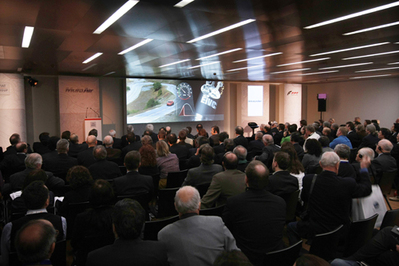
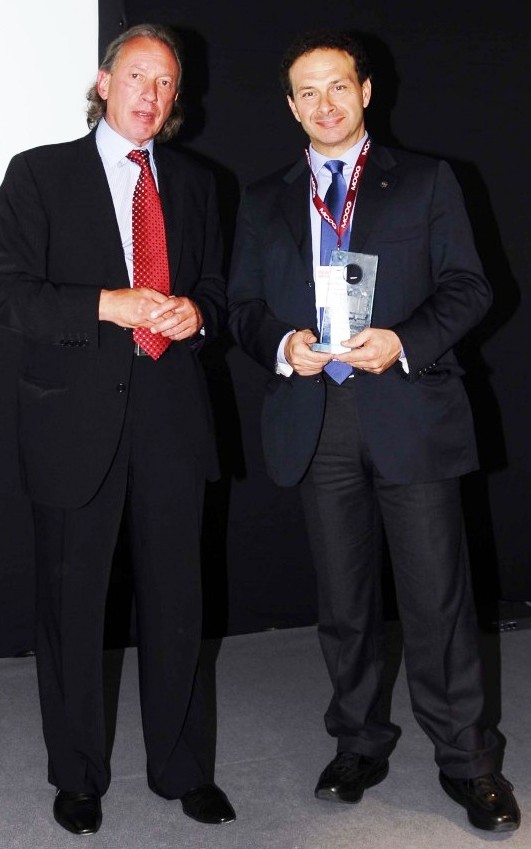
The MultiAir technology. The “Best New Engine of the Year” award, assigned by an international jury of 65 specialist journalists from 32 countries, was collected byAldo Marangoni, FPT Product Engineering Vice President.
Photo: Fiat Powertrain Technologies S.p.A. |
| |
Turin - June 24, 2010
The FPT 1.4 Turbo engines, the first to incorporate revolutionary MultiAir technology, won the
prestigious “Engine of the Year” award in the best new engine of the year category.
These innovative
four-cylinder engines combine MultiAir, the electro-hydraulic management of the inlet valves, with turbocharger, setting new efficiency standards.
Developed and manufactured by
FPT – Fiat Powertrain Technologies, the
1.4 MultiAir Turbo engines, with power outputs that range from 135 to 170 bhp, now equip, optimizing “downsizing” concept, the
Alfa Romeo MiTo and
Giulietta, as well as the
Fiat Punto Evo and
Abarth Punto Evo, and will soon be introduced on the
Fiat Bravo and
Lancia Delta.
The top range 170 bhp version, with 124 bhp/litre, has an outstanding specific power output which, combined with peak torque of 250 Nm, guarantees sporty performances, but also record-setting fuel consumption and emissions - 134 g/km of CO2 on the new
Alfa Romeo Giulietta.
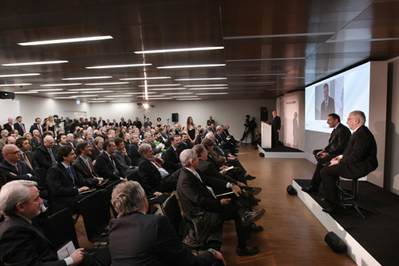 |
The MultiAir technology. The “Best New Engine of the Year” award, assigned by an international jury of 65 specialist journalists from 32 countries, was collected byAldo Marangoni, FPT Product Engineering Vice President.
Photo: Fiat Powertrain Technologies S.p.A. |
| |
MultiAir technology, which already won numerous prizes, is based on direct control of the intake air, cylinder by cylinder and stroke by stroke, without a throttle valve, and it reduces fuel consumption and CO2 emissions by as much as 10%, while increasing the power output by 10% and improving torque by 15%.
What is more, all polluting emissions are also reduced by careful monitoring of combustion.
MultiAir technology is versatile, easily applicable to all petrol engines, and has the potential to be developed for diesel engines in future.
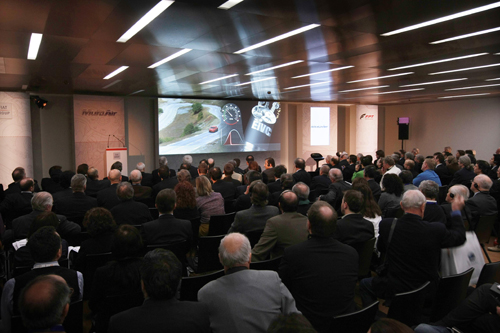
The “Best New Engine of the Year” award, assigned by an international jury of 65 specialist journalists from 32 countries, was collected by
Aldo Marangoni, FPT Product Engineering Vice President.
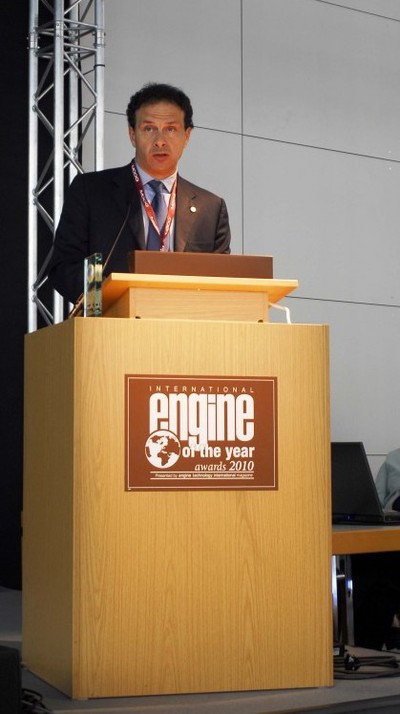 |
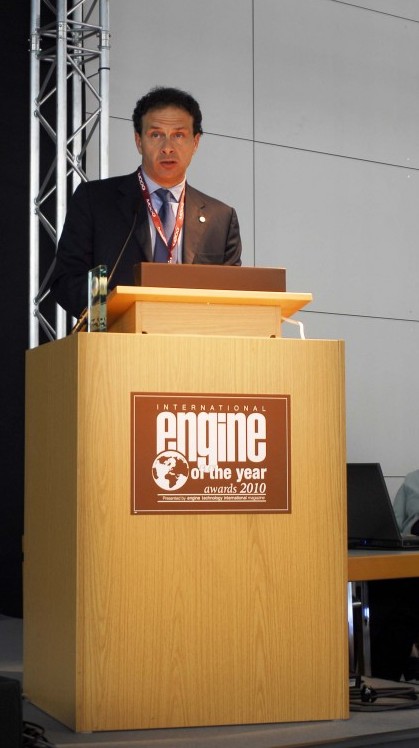
Aldo Marangoni, FPT Vice President Product Engineering, at the award “Engine of the Year”.
Photo: Fiat Powertrain Technologies S.p.A. |
| |
“The award is further confirmation of the Fiat Group’s acknowledged capacity for technological innovation; the Group had already won the prize in 2005, in the 1.0 to 1.4 litre capacity class of the “International Engine of the Year”, with the small but sophisticated 1.3 Multijet, which opened a new chapter in the history of diesel engines, a field in which the Group has always been a leader, having been the first to launch innovations such as direct injection and common-rail technology on the market”, said
Aldo Marangoni.
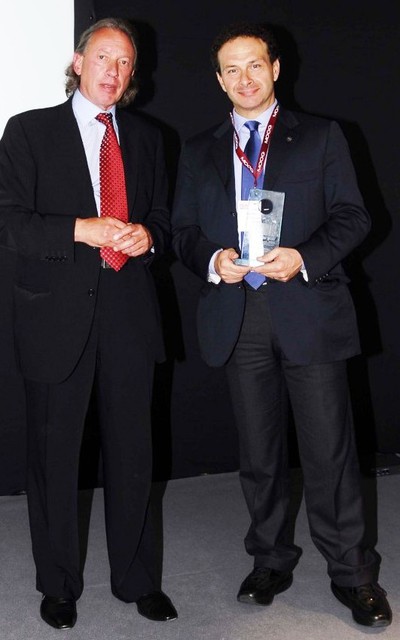 |
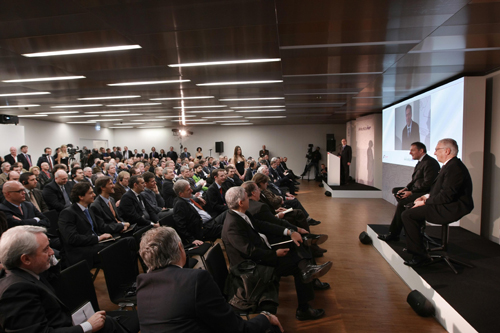
Aldo Marangoni, FPT Vice President Product Engineering, and Tony Robinson, founder and CEO of UKiP Media & Events, at the award “Engine of the Year”.
Photo: Fiat Powertrain Technologies S.p.A. |
| |
"Lots of power combined with serious inroads made in emissions reduction makes this a very good engine. Then, when you look at the fuel economy, Fiat's MultiAir turbo powertrain becomes a great engine - it's easy to see why it has won Best New Engine for 2010", said
Dean Slavnich, Co-Chairman of the Awards, and editor of Engine Technology International.
Fiat Powertrain Technologies S.p.A.
Press office
Via Puglia 15
10156 Torino
Italia
Tel. +39 011 0072044
press@fptpowertrain.com
www.fptpowertrain.com
http://www.fiatgroupautomobilespress.com/index.php?lng=2&group=6&method=cartelle&action=zoom&id=4795
Fiat Powertrain Technologies
FPT - Fiat Powertrain Technologies is the
Fiat Group company specialized in and dedicated to research, development, production and sale of engines and transmissions.
With its annual output of around 2.6 million engines, 2.4 million transmissions and axles,
20,000 employees, 22 plants, 14 research centres and a dealer network in
over 100 countries, FPT is one of the most significant players in the powertrain sector worldwide.
FPT develops, produces and sells engines covering a power range from 20 to 870 HP for different sectors and applications: from automotive to industrial, from marine to power generation.
The in-house know-how in
Research & Development and the great expertise in
Engineering & Production provide excellent powertrain solutions and innovations.
Around
2,500 specialised technicians work on the development and engineering of innovative technologies.
The numerous new patents and inventions filed each year confirm the top level results and excellence of their work.
http://www.fptpowertrain.com/eng/home.htm
The Fiat MultiAir Technology: some history
In the last decade, the development of the
Common Rail technology for Diesel engines marked a breakthrough in the
passenger car market.
To be competitive also in the field of gasoline engines,
Fiat Group decided to follow the same approach and focus on breakthrough technologies.
The aim was to provide customers with substantial benefits in terms of fuel economy and fun to drive while maintaining the engine intrinsic comfort characteristics, based on a smooth combustion process and on light structures and components.
The key parameter to
control Diesel engine combustion and therefore performance, emissions and fuel consumption is the quantity and characteristics of the fuel injected into cylinders.
That is the reason why the
Common Rail electronic Diesel fuel injection system was such a fundamental breakthrough in
Direct Injection Diesel engine technology.
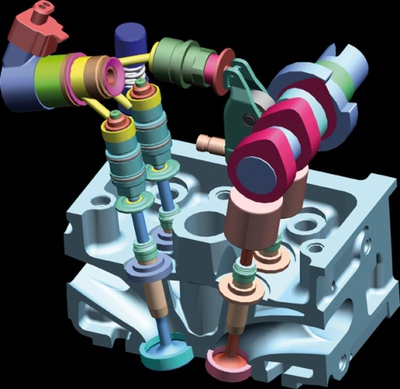 |
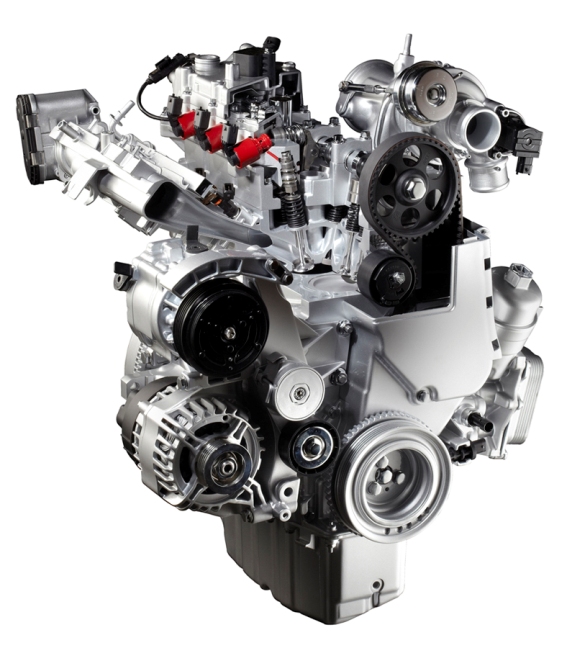
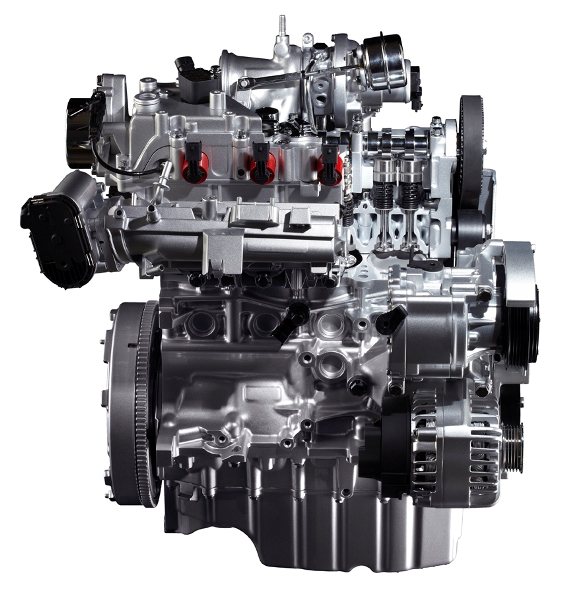
The MultiAir technology model. These innovative four-cylinder engines combine MultiAir, the electro-hydraulic management of the inlet valves, with turbocharger, setting new efficiency standards.
Photo: Fiat Powertrain Technologies S.p.A. |
| |
The key parameter to control gasoline engine combustion, and therefore performance, emissions and fuel consumption, is the quantity and characteristics of the fresh air charge in the cylinders.
In conventional gasoline engines the air mass trapped in the cylinders is controlled by keeping the intake valves opening constant and adjusting upstream pressure through a throttle valve.
One of the drawbacks of this simple conventional mechanical control is that the engine wastes about 10% of the input energy in pumping the air charge from a lower intake pressure to the atmospheric exhaust pressure.
A fundamental breakthrough in air mass control, and therefore in gasoline engine technology, is based on direct air charge metering at the cylinder inlet ports by means of an advanced electronic actuation and control of the intake valves, while maintaining a constant natural upstream pressure.
Research on this key technology started in the 80’s, when engine electronic control technologies reached the stage of mature technologies.
The Fiat MultiAir Technology: how it works
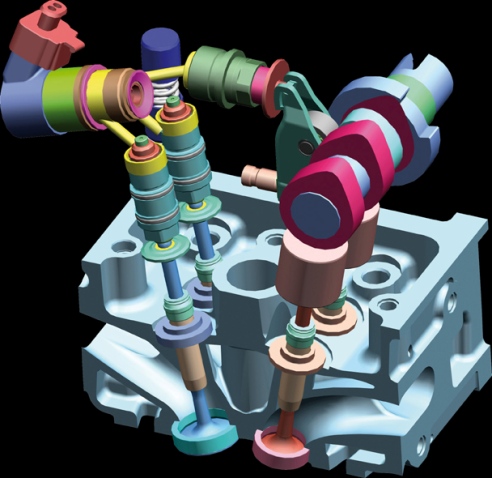
The operating principle of the system, applied to intake valves, is the following: a piston, moved by a mechanical intake cam lobe, is connected to the intake valve through a hydraulic chamber, which is controlled by a normally
open on/off Solenoid Valve.
When the Solenoid Valve is closed, the oil in the hydraulic chamber behaves like a solid body and transmits to the intake valves the lift schedule imposed by the mechanical intake cam.
When the solenoid valve is open, the hydraulic chamber and the intake valves are decoupled; the intake valves do not follow the intake cam anymore and close under the valve spring action.
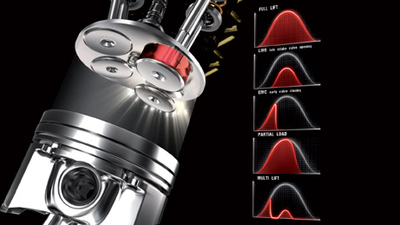 |
MultiAir technology, which already won numerous prizes, is based on direct control of the intake air, cylinder by cylinder and stroke by stroke, without a throttle valve, and it reduces fuel consumption and CO2 emissions by as much as 10%, while increasing the power output by 10% and improving torque by 15%.
Photo: Fiat Powertrain Technologies S.p.A. |
| |
The final part of
the valve closing stroke is controlled by a dedicated hydraulic brake, to ensure a soft and regular landing phase in any engine operating conditions.
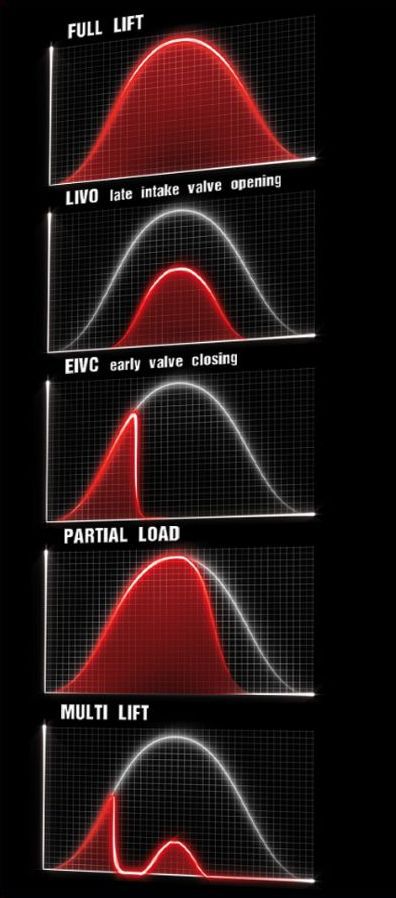
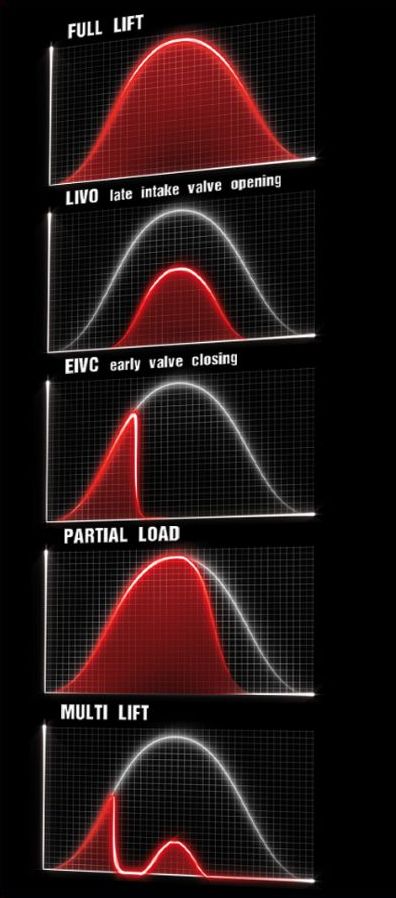
Through Solenoid Valve opening and closing time control, a wide range of optimum intake valve opening schedules can be easily obtained.
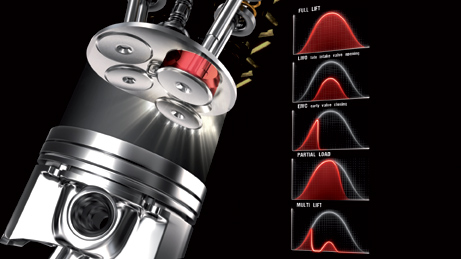
For maximum power, the Solenoid Valve is always closed and full valve opening is achieved following completely the mechanical cam, which was specifically designed to maximize power at high engine speed (long opening time).
For low-rpm Torque, the Solenoid Valve is opened near the end of the cam profile, leading to early intake valve closing.
This eliminates unwanted backflow into the manifold and maximizes the air mass trapped in the cylinders.
 |
MultiAir technology, which already won numerous prizes, is based on direct control of the intake air, cylinder by cylinder and stroke by stroke, without a throttle valve, and it reduces fuel consumption and CO2 emissions by as much as 10%, while increasing the power output by 10% and improving torque by 15%.
Photo: Fiat Powertrain Technologies S.p.A. |
| |
In engine part load, the
Solenoid Valve is opened earlier causing partial valve openings to control the trapped air mass as a function of the required torque.
Alternatively the intake valves can be partially opened by closing the
Solenoid Valve once the mechanical cam action has already started.
In this case the air stream into the cylinder is faster and results in higher in-cylinder turbulence.
The last two actuation modes can be combined in the same intake stroke, generating a so-called
“Multilift” mode, that enhances turbulence and combustion rate at very low loads.
The MultiAir Technology Benefits
The MultiAir Technology potential benefits for gasoline engines exploited so far can be summarized as follows:
•
Maximum Power is increased by up to 10% thanks to the adoption of a power-oriented mechanical cam profile
•
Low-rpm Torque is improved by up to 15% through early intake valve closing strategies that maximize the air mass trapped in the cylinders.
•
Elimination of pumping losses brings a 10% reduction of Fuel Consumption and CO2 emissions, both in Naturally Aspirated and Turbocharged engines with the same displacement
•
MultiAir Turbocharged and downsized engines can achieve up to 25% Fuel Economy improvement over conventional Naturally Aspirated engines with the same level of performance
•
Optimum valve control strategies during engine warm-up and internal Exhaust Gas Recirculation, realized by reopening the intake valves during the exhaust stroke, result in emissions reduction ranging from 40% for HC / CO to 60% for NOx
•
Constant upstream air pressure, atmospheric for Naturally Aspirated and higher for Turbocharged engines, together with the extremely fast air mass control, cylinder-by-cylinder and stroke-by-stroke, result in a superior dynamic engine response.
Application of the MultiAir Technology to FPT Engines
The first world-wide application of the
MultiAir technology will be the
Fire 1400cc 16V Naturally Aspirated and Turbocharged engines.
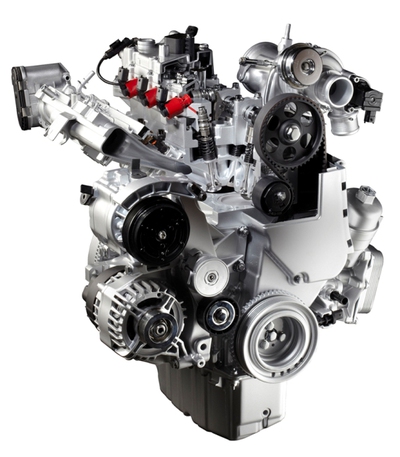 |
The FPT 1.4 Turbo engines, the first to incorporate revolutionary MultiAir technology, won the prestigious “Engine of the Year” award in the best new engine of the year category.
Photo: Fiat Powertrain Technologies S.p.A. |
| |
The second application is a new
Small Gasoline Engine (SGE - 900cc Twincylinder) where cylinder head design has been specifically optimized for the
MultiAir actuator integration.
Here again, there will be both a
Naturally Aspirated and a
Turbocharged version. A specific
Turbocharged engine version will be bi-fuel (gasoline- CNG).
 |
The FPT 1.4 Turbo engines, the first to incorporate revolutionary MultiAir technology, won the prestigious “Engine of the Year” award in the best new engine of the year category.
Photo: Fiat Powertrain Technologies S.p.A. |
| |
Thanks to radical downsizing, the
Turbocharged Small Gasoline Engine achieves
Diesel-like CO2 emission levels, which are further reduced in its Natural Gas version with CO2 emissions lower than 80 g/km in many vehicle applications.
Further Potential of the MultiAir Technology
All breakthrough technologies open a new world of further potential benefits, which are usually not fully exploited in the first generation, in order to minimize industrial risk.
The Common Rail technology, a Fiat worldwide premiere in 1997, paved the way to more than a decade of further technological evolutions such as “
Multijet” for multiple injections,
Small Diesel Engines and the very recent
Modular Injection technology, soon to be launched on the market.
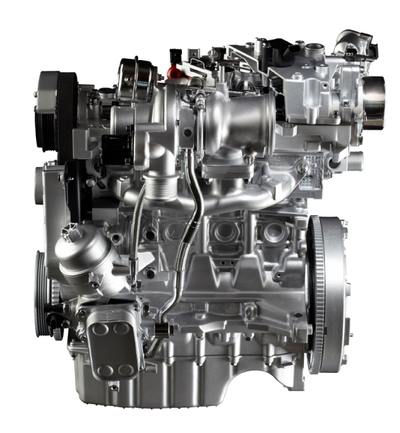 |
The FPT 1.4 Turbo engines, the first to incorporate revolutionary MultiAir technology, won the prestigious “Engine of the Year” award in the best new engine of the year category.
Photo: Fiat Powertrain Technologies S.p.A. |
| |
Similarly, the
MultiAir technology, a Fiat worldwide premiere in 2009, will pave the way to a wave of further technological evolutions for gasoline engines:
•
Integration of the MultiAir Direct air mass control with Direct gasoline Injection to further improve transient response and fuel economy.
•
Introduction of more advanced multiple valve opening strategies to further reduce emissions.
•
Innovative engine-Turbocharger matching to control trapped air mass through combination of optimum boost pressure and valve opening strategies.
While electronic gasoline fuel injection developed in the 70’s and Common Rail developed in the 90’s were fuel specific breakthrough technologies, the
MultiAir Electronic Valve Control technology can be applied to all internal combustion engines whatever fuel they burn.
MultiAir, initially developed for
Spark Ignition engines burning light fuel ranging from gasoline to
Natural Gas and hydrogen, has wide potential also for
Diesel engine emissions reduction.
Intrinsic NOx reduction of up to 60% can be obtained by
internal Exhaust Gas Recirculation (iEGR) realized with intake valves reopening during the exhaust stroke, while optimal valve control strategies during cold start and warm-up bring up to 40% HC and CO reduction of emissions.
 |
The FPT 1.4 Turbo engines, the first to incorporate revolutionary MultiAir technology, won the prestigious “Engine of the Year” award in the best new engine of the year category.
Photo: Fiat Powertrain Technologies S.p.A. |
| |
Further substantial reduction comes from the more efficient management and regeneration of the
Diesel Particulate Filter and
NOx Storage Catalyst, thanks to the highly dynamic air mass flow control during transient engine operation.
Diesel engine performance improvement is similar to that of the gasoline engine and is based on the same physical principles.
Instead, fuel consumption benefits are limited to few percentage points because of the low pumping losses of
Diesel engines, one of the reasons of their superior fuel economy.
In the future, powertrain technical evolution might benefit from a progressive
unification of gasoline and Diesel engines architectures.
A
MultiAir engine cylinder head can be therefore conceived and developed, where both combustion systems can be fully optimized without compromises.
Moreover the
MultiAir electro-hydraulic actuator is physically the same, with minor machining differences, while internal subcomponents are all carry over from the
Fire and
SGE applications.
http://www.fptmultiair.com/flash_multiair_eng/Cartella%20Stampa%20ENG%20def%20_3_.pdf



 subskrypcja RSS























 strona: 1 z 1