 |
|
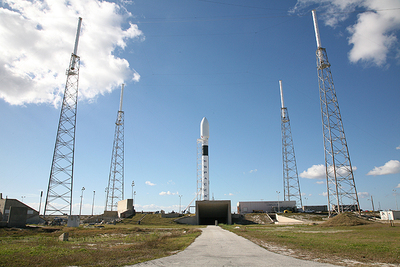
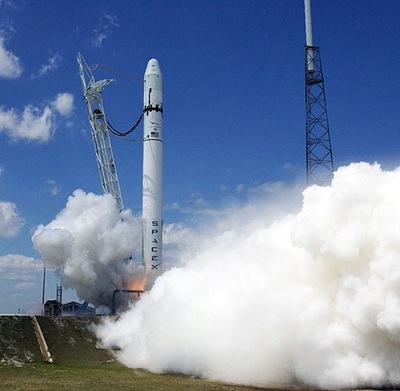
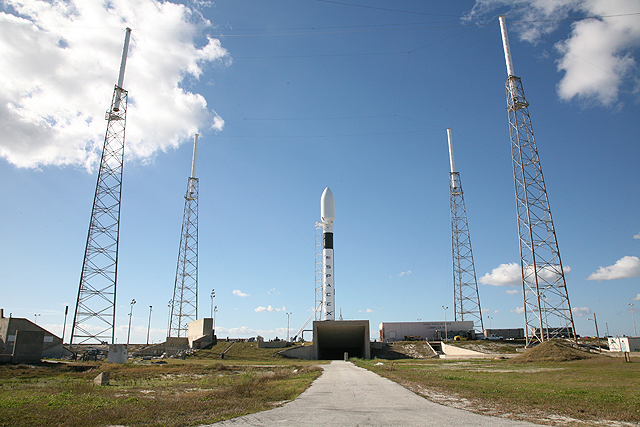
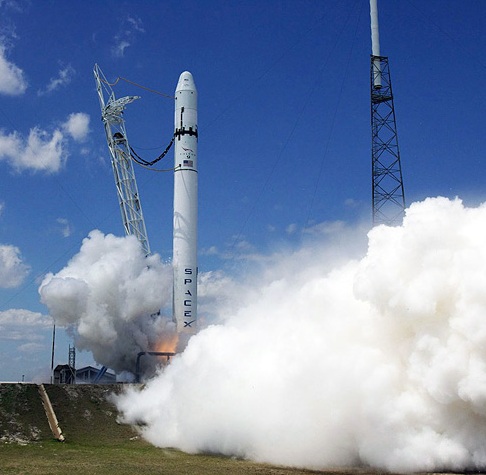
The SpaceX Falcon 9 rocket stands vertical on its launch pad at Cape Canaveral, FL. The SpaceX team completed vehicle integration on December 30, 2008, and the new SpaceX-built transporter and erector system raised the 12 foot diameter, 180 foot long rocket to vertical via massive hydraulic cylinders.
Credit: SpaceX
|
| |
Friday, June 4, 2010
Today,
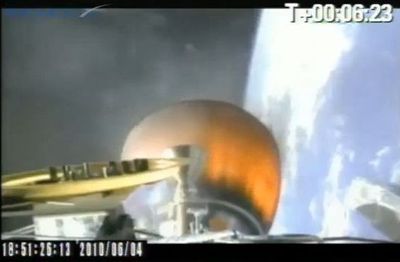
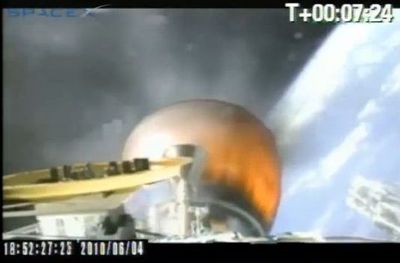
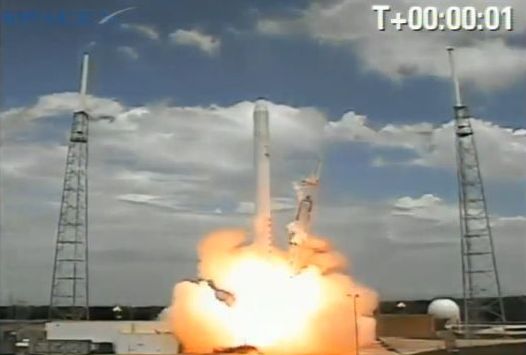
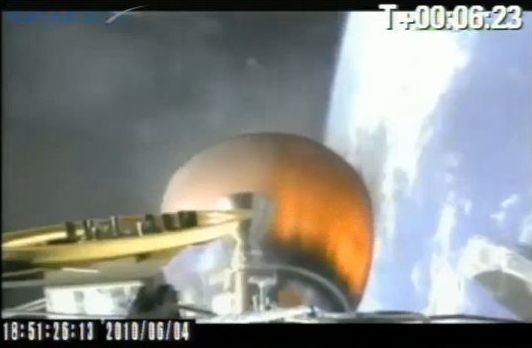
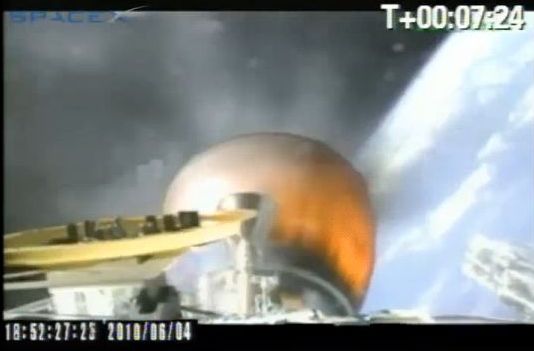
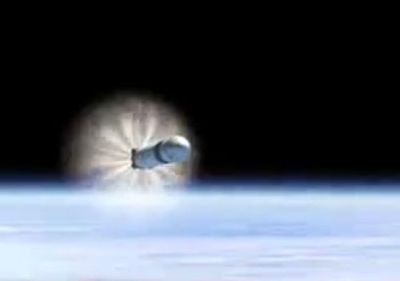
SpaceX’s first Falcon 9 has successfully achieved Earth orbit.
This has been a great day for
SpaceX and a promising step forward for the
US space program, as we make progress towards expanding the human presence in space.
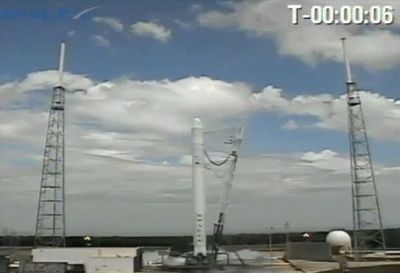 |
SpaceX’s first Falcon 9 has successfully achieved Earth orbit.
Credit: SpaceX |
| |
Click here to watch
video of the first successful flight of
Falcon 9:
http://www.spacex.com/updates.php
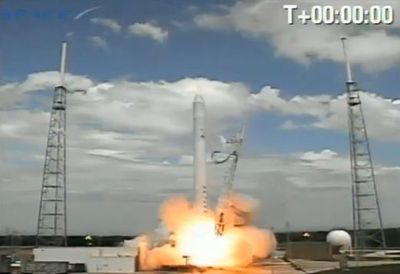 |
SpaceX’s first Falcon 9 has successfully achieved Earth orbit.
Credit: SpaceX |
| |
SpaceX extends special thanks to all of our long-time supporters, all our
NASA, Government, and
Commercial customers, and the
United States Air Force and
Cape Canaveral Air Force Station for their excellent, ongoing support.
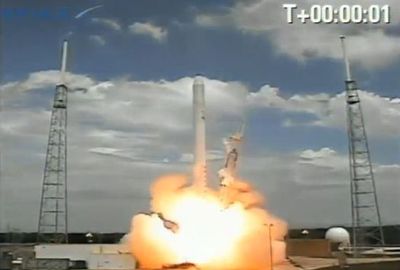 |
SpaceX’s first Falcon 9 has successfully achieved Earth orbit.
Credit: SpaceX |
| |
http://www.spacex.com/updates.php
Preparations For First Falcon 9 Launch
Thursday, May 6, 2010
As we continue to progress towards the
first Falcon 9 launch from Cape Canaveral, certification of the
flight termination system (FTS) and subsequent range availability remain the two primary schedule drivers.
 |
SpaceX’s first Falcon 9 has successfully achieved Earth orbit.
Credit: SpaceX |
| |
Air Force Range safety requires the
FTS system, which allows them to safely end the launch should the vehicle stray from its designated flight corridor.
 |
SpaceX’s first Falcon 9 has successfully achieved Earth orbit.
Credit: SpaceX |
| |
The system consists of a command receiver and an ordnance system designed to split the vehicle's fuel and liquid oxygen tanks in the event of an errant flight.
SpaceX is working closely with Ensign Bickford to complete testing of the explosive elements of the
FTS system, but there are other components, such as the
FTS radios, antennas and the transponder that come from other suppliers as well.
 |
SpaceX’s first Falcon 9 has successfully achieved Earth orbit.
Credit: SpaceX |
| |
All of these components must be qualified specifically for our flight environments, so unfortunately, it is not simply a case of buying “
off the shelf”.
FTS testing is an iterative process where the number of remaining tests depends on the results of previous tests, making it very difficult to predict a completion date.
 |
| Credit: SpaceX |
| |
Once testing is complete, final data is submitted to
SpaceX and
Air Force Range safety officials for review and acceptance.
Much of the range calendar for May is already reserved for other activities, so range availability will be a key factor in identifying a launch date.
 |
| Credit: SpaceX |
| |
Fortunately the
FTS is the last remaining significant milestone--the vehicle is otherwise ready for flight, so once we complete certification, we will be “
all systems go” for launch.
http://www.spacex.com/updates.php
A message from Peter Diamandis, on behalf of the X PRIZE Foundation
June 4, 2010
Falcon 9 Soars to Space
Today we congratulate
SpaceX, a company founded and run by
X PRIZE Trustee Elon Musk, on the
first successful launch of the Falcon 9 from Cape Canaveral.
This inaugural test flight is an important step forward after many years of hard work in design, development, and construction of both the new launch vehicle and the
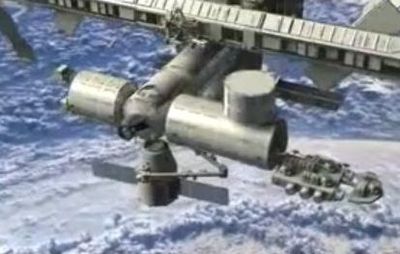
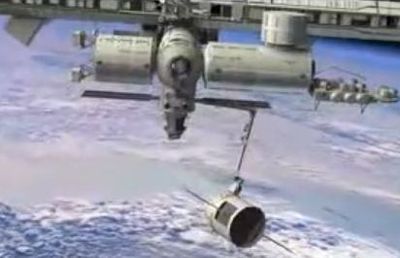
Dragon capsule, both of which will be used in future missions to ferry cargo and crew to the
International Space Station.
 |
| Credit: SpaceX |
| |
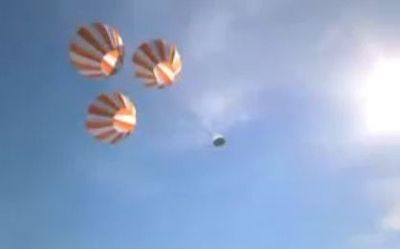
Today’s flight provided essential testing of the
Falcon 9 and the
Dragon qualification unit, providing invaluable data for
SpaceX as they continue to develop their space vehicles and operations.
The maiden voyage of the
Falcon 9 marks an important milestone in commercial spaceflight, proving what is achievable by privately-owned companies that are dedicated to pioneering new technologies and making space more accessible.
 |
| Credit: SpaceX |
| |
Overcoming the high cost of launching to orbit continues to be a challenge faced by space-related ventures, and the emergence of launch vehicles such as the
Falcon 9 contributes to an increasingly competitive environment in the launch vehicle market – a condition which has the potential to drive costs down and open the space frontier to the rest of us.
 |
|
Static test firing of the Falcon 9 first stage, conducted at SpaceX's launch site, Cape Canaveral, Florida on March 13, 2010.
Credit: SpaceX / Chris Thompson.
|
| |
In the not-too-distant future, we hope to see
SpaceX and other commercial launch providers transporting crew and cargo to orbiting outposts, the
Moon, asteroids, and even
Mars.
Also commendable is the continuous dedication to quality, reliability, and safety by
SpaceX as they move forward with their ambitious plans.
This mindset is one of the many reasons that
SpaceX is a
Preferred Partner for the Google Lunar X PRIZE, and it is worth noting that several of the teams entered in the competition are already considering utilizing rockets such as the
Falcon 9 to boost their robots to the Moon in pursuit of the
$30 million in prizes.
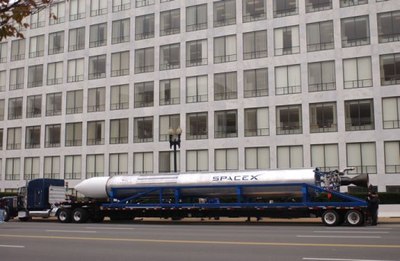 |
|
Falcon in front of FAA in Washington, D.C.
Credit: SpaceX
|
| |
Again, congratulations to the entire
SpaceX team on a successful launch today.
We wish them the best as they continue to progress higher and faster toward their bold space exploration goals.
http://thelaunchpad.xprize.org/2010/06/falcon-9-soars-to-space.html
About X PRIZE Foundation
The mission of the
X PRIZE Foundation is to bring about radical breakthroughs for the benefit of humanity. We do this by creating and managing prizes that drive innovators to solve some of the greatest challenges facing the world today.
The X PRIZE is viewed as the leading model to leverage the elements of public interest, entrepreneurial spirit and cross-disciplinary innovation to bring about breakthroughs that benefit us all.
We believe that a small group of people with passion for a cause can achieve that which has never been attained. This is why we stage competitions that challenge issues that matter most.
http://www.xprize.org/about
About SpaceX
In an era when most technology based products follow a path of ever-increasing capability and reliability while simultaneously reducing costs, launch vehicles today are little changed from those of 40 years ago.
SpaceX aims to change this paradigm by developing a family of launch vehicles which will ultimately reduce the cost and increase the reliability of space access by a factor of ten.
Coupled with the newly emerging market for private and commercial space transport, this new model will re-ignite humanity's efforts to explore and develop
Space.
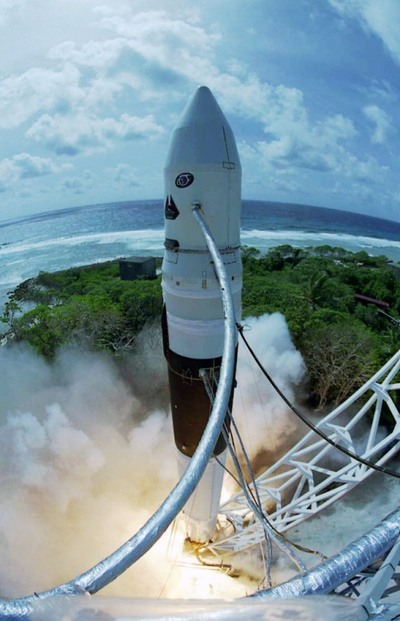 |
|
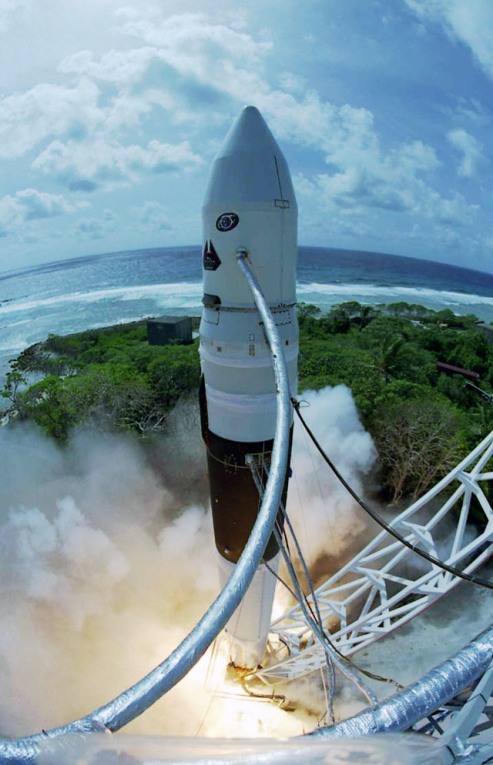
Falcon 1 at SpaceX launch pad, Kwajalein Atoll.
Credit: Thom Rogers / SpaceX
|
| |
Our company is based on the philosophy that simplicity, low-cost, and reliability can go hand in hand.
By eliminating the traditional layers of management, internally, and sub-contractors, externally, we reduce our costs while speeding decision making and delivery.
Likewise, by keeping the vast majority of manufacturing in house, we reduce our costs, keep tighter control of quality, and ensure a tight feedback loop between the design and manufacturing teams.
And by focusing on simple, proven designs with a primary focus on reliability, we reduce the costs associated with complex systems operating at the margin.
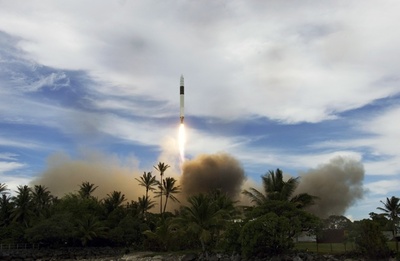 |
|
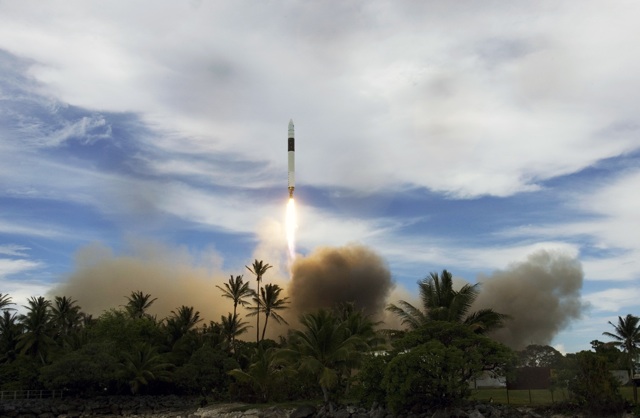
Liftoff of the Falcon 1 RazakSAT mission, from the SpaceX launch site on Omelek Island, US Army Kwajalein Atoll, in the Central Pacific, on 14 July 2009 at 03:35 UTC.
Credit: SpaceX
|
| |
Established in 2002 by Elon Musk, the founder of PayPal and the Zip2 Corporation, SpaceX has already developed two brand new launch vehicles, established an impressive launch manifest, and been
awarded COTS funding by NASA to demonstrate delivery and return of cargo to the
International Space Station.
| |
 |
| |
Credit: SpaceX |
| |
Supported by this order book and Mr. Musk's substantial resources,
SpaceX is on an extremely sound financial footing as we move towards volume commercial launches.
Although drawing upon a rich history of prior launch vehicle and engine programs,
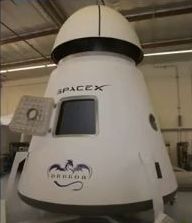
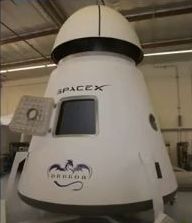
SpaceX is privately developing the Dragon crew and cargo capsule and the
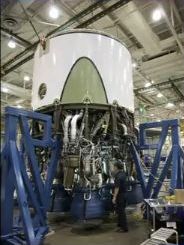
Falcon family of rockets from the ground up, including main and upper stage engines, the cryogenic tank structure, avionics, guidance & control software and ground support equipment.
| |
 |
| |
Credit: SpaceX |
| |
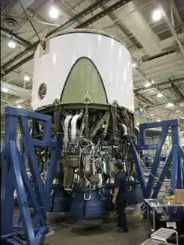
With the
Falcon 1, Falcon 9 and
Falcon 9 Heavy launch vehicles, SpaceX is able to offer a full spectrum of light, medium and heavy lift launch capabilities to our customers.
We are able to deliver spacecraft into any inclination and altitude, from low
Earth orbit to geosynchronous orbit to planetary missions.
The Falcon 9 and Falcon 9 Heavy are the only
US launch vehicles with true engine out reliability.
They are also designed such that all stages are reusable, making them the world's first fully reusable launch vehicles.
| |
 |
| |
Credit: SpaceX |
| |
And our
Dragon crew and cargo capsule, currently under development, will revolutionize access to space by providing efficient and reliable transport of crew and cargo to the
ISS and other LEO destinations.
Our design and manufacturing facilities are located near the Los Angeles International airport, leveraging the deep and rich aerospace talent pool available in
Southern California.
Our
extensive propulsion and structural test facilities are located in Central Texas.
We currently have launch complexes available in
Vandenberg and
Kwajalein Island, and in April 2007 we were granted use of and began developing
Space Launch Complex 40 at Cape Canaveral.
http://www.spacex.com/company.php
Gwynne Shotwell
President of Space Exploration Technologies (SpaceX)
Ms. Shotwell joined SpaceX in 2002 as Vice President of Business Development, developing SpaceX’s customer base and managing strategic relations.
As President, Ms. Shotwell’s responsibilities include providing strategic direction to support company growth and development, as well as management of day-to-day operations at SpaceX.
Her experience prior to SpaceX includes over ten years at the Aerospace Corporation where she held positions of increasing responsibility in Space Systems Engineering and Technology and Project Management.
 |
|
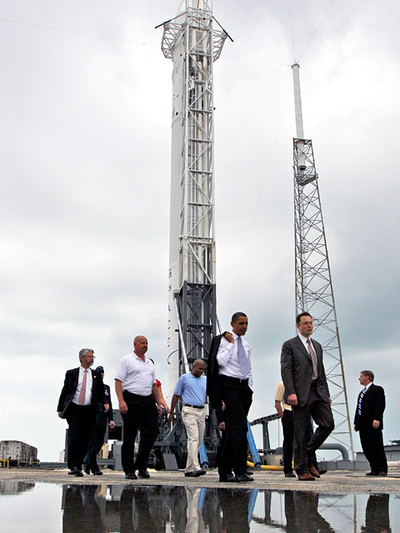
President Barack Obama and SpaceX CEO and CTO Elon Musk at the SpaceX Falcon 9 launch pad, Cape Canaveral, Florida on April 15, 2010. SpaceX's Leslie Woods Jr. and NASA Administrator Charles Bolden in background.
Credit: SpaceX / AP
|
| |
Highlights include promotion to Chief Engineer of an MLV-class Satellite program, managing a landmark study for the Federal Aviation Administration’s on Commercial Space Transportation, and completing an extensive space policy analysis for NASA’s future investment in space transportation.
After Aerospace Corporation, Ms. Shotwell was recruited to be manager of the Space Systems Division at Microcosm, where she served on the Executive committee and directed corporate business development.
Ms. Shotwell received her Bachelor’s and Master’s Degree from Northwestern University in Mechanical Engineering and Applied Mathematics.
She was Elected statewide to the Board of Directors, California Space Authority and serves on its Executive committee.
She has also served as an officer of the Space Systems Technical Committee and the local Chapter of the AIAA.
She has authored papers in a wide variety of areas including standardizing spacecraft/payload interfaces, conceptual small spacecraft design, infrared signature target modeling, Space Shuttle integration, and reentry vehicle operational risks.
Elon Musk
CEO and CTO of Space Exploration Technologies (SpaceX)
Elon Musk is the chief executive officer and chief technology officer of Space Exploration Technologies (SpaceX), which develops rockets and spacecraft for missions to Earth orbit and beyond.
Musk served as chief engineer for Falcon 1, the first privately developed liquid fuel rocket to reach orbit, as well as Falcon 9 and the Dragon spacecraft.
 |
|
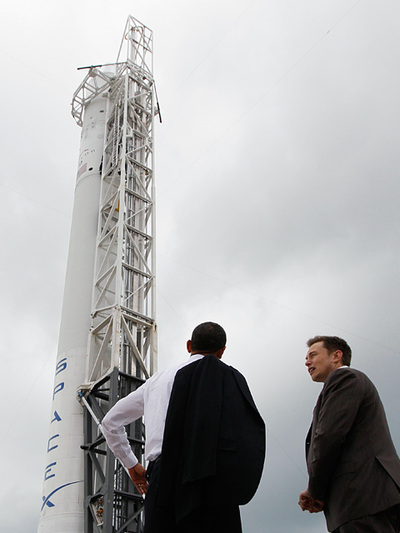
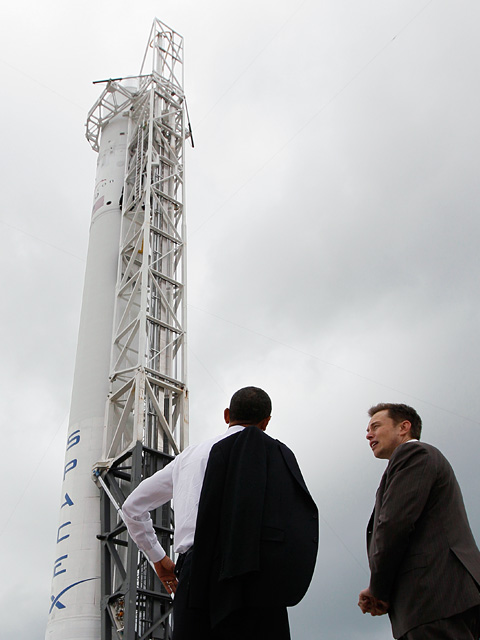
President Obama and Elon Musk.
Credit: SpaceX / AP.
|
| |
In 2008, SpaceX won the NASA contract to replace the cargo transport function of the Space Shuttle with Falcon 9 and Dragon.
President Obama and NASA Administrator Bolden decided in 2010 to outsource astronaut transport to the commercial sector.
F9/Dragon is considered by many to be the leading system for that role.
Musk’s other primary activity is serving as CEO and Product Architect of Tesla Motors, where he has overseen product development and design from the beginning, including the all electric Tesla Roadster and Model S sedan.
Musk is also the non-executive chairman of SolarCity, the leading provider of solar power systems in California.
Prior to SpaceX, Musk co-founded PayPal, the world's leading Internet payment system, and served as the company's Chairman and CEO.
Before PayPal, Musk co-founded Zip2, a provider of Internet software to the media industry.
 |
|
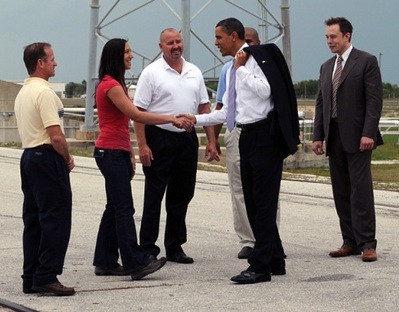
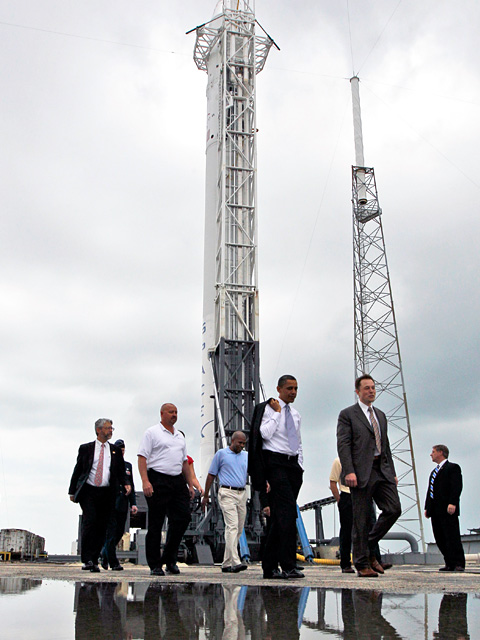
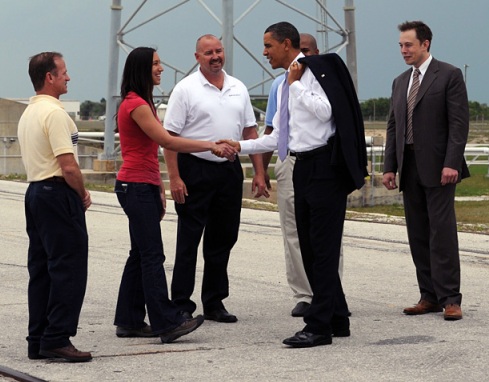
Meeting the President at the Falcon 9 launch site, from left: Neil G. Hicks, Florence Li, Brian Mosdell, President Obama, Leslie Woods Jr., and Elon Musk.
Credit: SpaceX / Getty Images.
|
| |
In 2007, Musk was recognized for his work by Research and Development Magazine’s, receiving their Innovator of the Year Award.
He received the 2007/2008 American Institute of Aeronautics and Astronautics award for the greatest contribution to the field of space transportation.
In 2008, Musk was named as one of the 75 most influential people of the 21st century by Esquire magazine and received the Aviation Week 2008 Laureate for the most significant achievement worldwide in the space industry.
In 2009, the National Space Society awarded Musk their Von Braun Trophy, given for leadership of the most significant achievement in space.
Most recently in 2010, Musk was recognized as a Living Legend in Aviation by the Kitty Hawk Foundation for creating the Falcon 9 rocket and Dragon spacecraft.
He has a physics degree from the University of Pennsylvania, a business degree from Wharton and currently serves as a member of the Stanford University Engineering Advisory Board.
http://www.spacex.com/company.php
Video
SpaceX Falcon 9x3 – Space Pod 2010.05.11
http://www.youtube.com/watch?v=XYCPu14Bq54&feature=related
Video
Falcon 9 - Dragon (SpaceX)
http://www.youtube.com/watch?v=69rBVRWkIEQ&feature=related
Video
SpaceX Successful First Stage Firing of Falcon 9
http://www.youtube.com/watch?v=kg7uDPSxE08&feature=related
Video
SpaceX Falcon 9 Maiden Launch Totally Successful
http://www.youtube.com/watch?v=sP5gykvTBpM&feature



 subskrypcja RSS





















 strona: 1 z 1