 |
Adobe revolutionizes how the world engages with ideas and information.
Photo: Adobe |
| |
At
Adobe, we believe that the open flow of creativity, ideas, and information should be limited only by the imagination. Innovation thrives when people are free to choose the technologies that enable them to openly express themselves and access information where and when they want.
Everyone loses when technological barriers impede the exchange of ideas.
 |
| Photo: Adobe |
| |
Openness is at
Adobe's core.
Our first technology was an open standard that liberated publishing from proprietary printing systems, and soon afterward our PDF technology eliminated barriers to sharing documents across platforms.
 |
| Photo: Adobe |
| |
Adobe® Flash® technology enables the delivery of content to hundreds of millions of people, regardless of platform or browser. In 2009, in partnership with
Google, Research In Motion, and dozens of other companies, we formed the
Open Screen Project, a coalition committed to making web experiences seamlessly available on any mobile device.
 |
| Photo: Adobe |
| |
We believe open markets that allow developers, publishers, and consumers to make their own choices about how they create, distribute, and access content are essential to progress. That's why we actively support technologies like
HTML4, HTML5, CSS, and
H.264, in addition to our own technologies.
 |
| Photo: Adobe |
| |
As the web and mobile devices facilitate the free exchange of ideas like never before, we stand at the leading edge of an amazing revolution.
We remain certain that openness is the only way forward.
http://www.adobe.com/choice/?promoid=GXSAD
Our thoughts on open markets
The genius of the Internet is its almost infinite openness to innovation.
New hardware. New software. New applications. New ideas.
They all get their chance.
 |
John Warnock and Chuck Geschke
Photo: Adobe |
| |
As the founders of Adobe, we believe open markets are in the best interest of developers, content owners, and consumers.
Freedom of choice on the web has unleashed an explosion of content and transformed how we work, learn, communicate, and, ultimately, express ourselves.
If the web fragments into closed systems, if companies put content and applications behind walls, some indeed may thrive — but their success will come at the expense of the very creativity and innovation that has made the Internet a revolutionary force.
We believe that consumers should be able to freely access their favorite content and applications, regardless of what computer they have, what browser they like, or what device suits their needs.
No company — no matter how big or how creative — should dictate what you can create, how you create it, or what you can experience on the web.
When markets are open, anyone with a great idea has a chance to drive innovation and find new customers.
Adobe's business philosophy is based on a premise that, in an open market, the best products will win in the end — and the best way to compete is to create the best technology and innovate faster than your competitors.
 |
John Warnock and Chuck Geschke
Photo: Adobe |
| |
That, certainly, was what we learned as we launched PostScript® and PDF, two early and powerful software solutions that work across platforms.
We openly published the specifications for both, thus inviting both use and competition.
In the early days, PostScript attracted 72 clone makers, but we held onto our market leadership by out-innovating the pack.
More recently, we've done the same thing with Adobe® Flash® technology.
We publish the specifications for Flash — meaning anyone can make their own Flash player. Yet, Adobe Flash technology remains the market leader because of the constant creativity and technical innovation of our employees.
We believe that Apple, by taking the opposite approach, has taken a step that could undermine this next chapter of the web — the chapter in which mobile devices outnumber computers, any individual can be a publisher, and content is accessed anywhere and at any time.
In the end, we believe the question is really this:
Who controls the World Wide Web?
And we believe the answer is:
nobody — and everybody, but certainly not a single company.
Chuck Geschke, John Warnock
Cofounders
Chairmen, Adobe Board of Directors

 http://www.adobe.com/choice/openmarkets.html
The truth about Flash
Recently there has been a surge in discussion about
Adobe® Flash® technology, and within that discussion, a fair amount of incorrect information has been communicated.
Touch
The Adobe Flash Player runtime was actually originally created as a technology for tablets with touch interfaces, and today, it has support for working on touch-based devices.
 |
| Photo: Adobe |
| |
For existing content developed with mouse input in mind,
Flash Player will automatically convert the touch events to mouse events when running on a touch device. This allows content designed for the desktop to work seamlessly on touch-based devices using
Flash Player.
For new content developed specifically with touch in mind, Flash Player 10.1 will provide a complete set of multitouch and gesture APIs.
Video
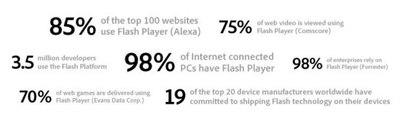
Seventy-five percent of all video on the web is viewed via Flash Player, including videos encoded in the most popular codecs such as
H.264 and
VP6.
There are many claims that
H.264 will kill
Flash.
However,
H.264 is a video codec (which requires a player), while
Flash Player is a complete multimedia runtime that can play back
H.264, among other codecs.
Furthermore,
Flash provides a solution for advanced video distribution, including support for technologies such as streaming, adaptive bitrate delivery, and content protection.
Of course, playing back high-definition video can be a
CPU-intensive task.
This is why
Flash Player 10.1 will include support for hardware-accelerated video playback across devices from mobile to desktop environments.
Now that the appropriate
APIs are available in
Mac OS X v10.6.3, we are also implementing
GPU-accelerated video on the Mac, available as a preview release
code-named Gala.
This can significantly improve
CPU usage as well as battery life.
Performance
Interactive content for Flash Player is dynamic and visual, and like all multimedia content and technologies, it requires more processing power than
static HTML documents.
Flash Player performs as well as, if not better than, comparable multimedia technologies.
The Flash Player team is constantly working to deliver the best performance for rich interactive media on the web.
On mobile devices, better performance translates into better battery life.
Adobe has made a number of further optimizations for the
Flash Player 10.1 release around code execution, memory use, hardware-accelerated video playback, and battery life.
Of course, since
Flash Player runs across platforms, all of the optimizations made for mobile will also benefit content on desktops, laptops, netbooks, and tablets when they run
Flash Player.
Security
Security is one of the highest priorities for the
Flash Player team.
The Symantec Global Internet Threat Report for 2009 found that
Flash Player had the second lowest number of vulnerabilities of all Internet technologies listed (which included both web plug-ins and browsers).
This is significant when you consider that
Flash Player is among the most widely distributed and used pieces of software in the world.
Given the complexity of modern software, security vulnerabilities are going to be present.
However,
Adobe has taken extensive steps to reduce the total number of issues as well as help ensure that when issues are found we can quickly address them and provide updates. This includes taking steps to ensure that users are able to get the latest
Flash Player updates as quickly as possible, and working with browser vendors to integrate
Flash Player privacy settings with those of the browser.
Openness
Flash Player is part of a rich ecosystem of both open and proprietary technologies.
The core engine of
Flash Player (AVM+) is open source and was donated to the
Mozilla Foundation, where it is actively maintained.
The file formats supported by
Flash Player, SWF and
FLV/F4V, as well as the
RTMP and
AMF protocols are freely available and openly published.
Anyone can use the specifications without requiring permission from
Adobe.
Third parties can and do build audio, video, and data services that compete with those from
Adobe.
There are no restrictions on the development of
SWF authoring tools, and anyone can build their own
SWF or
FLV/F4V player.
Flex, the primary application framework for the
Adobe Flash Platform, is also open source and is actively maintained and developed by Adobe and the community.
Finally, the
Flash Platform has a rich developer ecosystem of both open and proprietary tools and technologies, including developer
IDEs such as
FDT, IntelliJ, and
haXe; open source runtimes such as
Gnash; and open source video servers such as
Red5.
http://www.adobe.com/choice/flash.html
http://www.adobe.com/



 subskrypcja RSS





























 strona: 1 z 1