The New World of Work focuses on the design of work – to finally move away from the mindsets and processes of the post-Industrial era.
The power of a ‘user-centered’ approach, optimising the skills, efficiencies and effectiveness of every individual is increasing overall organisational productivity compared with 20th century company-centric models.
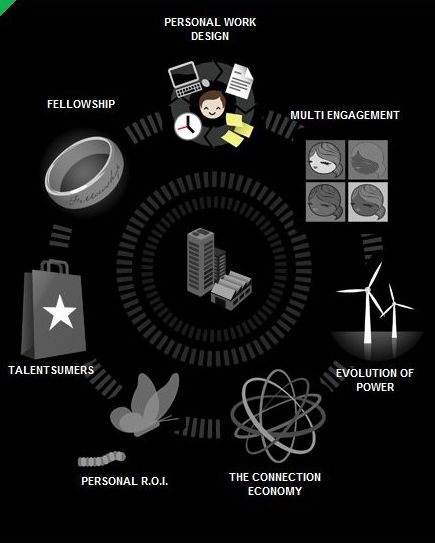
7 Pillars for Organisational Development in the New World of Work
PERSONAL WORK DESIGN
User Centred V's Corporate Centered
The tools available in the 21st century mean it is now easier than ever to work anywhere, at anytime, with anyone.
Have you ever heard your people say they are more productive working out of the ‘traditional’ office environment?
What does going to ‘work’ even mean these days?
Personal Work Design is about understanding the power of a more “user-centered” culture so every individual can capitalise on today’s tools and processes to achieve maximum productivity and engagement.
Think:
Why do we still have a rush hour?
Why are we still living a Mon - Fri, 9 - 5pm mentality?
Do we need to turn up to the same office, day in and day out to get stuff done?
MULTI ENGAGEMENT
Personal Engagement V's Mass Engagement
Employee engagement 1.0 involved a ‘corporate-centered’ monologue, rather like a temperature check, to gauge levels of engagement. Not very engaging or accurate.
Engagement in the NWoW is a dialogue across the organisation where every individual’s skills, passions, knowledge, networks and energy is understood and fully utilised.
Multi engagement is about going beyond ‘the job description’ to link engagement, productivity, customer service and retention.
Think:
Do you really know your people?
What do they do in their spare time?
What other skills could they bring to your organisation other than what is in their confined job description?
EVOLUTION OF POWER
Horizontal Power V's Vertical Power
The structure of organisations has barely changed from centuries ago?
How can structures, designed for a totally different world, still be effective in such rapidly changing environments?
Evolving power throughout the organisation means fostering a culture of trust and understanding.
As consumers, the power has evolved - it is no longer with the few, it is with the masses.
The same is happening in the workplace.
Think:
How much power do your people really have over how they work, whom they work with and when they work.
Are they contributing to the success and future of the organisation, or just a number?
CONNECTION ECONOMY
Internal and External Collaboration V's Internal Teams
The Connection Economy goes beyond the traditional boundaries and taps into horizontal and external sources of knowledge.
Open Sourcing, Open sharing, Crowd Sourcing and Social Networking are all crucial in the New World of Work.
Connection Economy is about understanding how easy it is for your people to find people and access knowledge to do their job quickly and effectively.
It moves from ‘document searching’ to truly understanding the communication map within your organisation and creates a culture of ‘expertise search.’
Think:
How does work really get done within your organisation?
How are people connecting and collaborating, internally and externally?
Do we know where the blockages are?
Who are the people who know who to go to, to get stuff done?
PERSONAL ROI
Personal Return V's Corporate Return
PROI is a quantum leap from viewing productivity as a ‘return’ solely from the employer’s perspective.
PROI is treating both the employee and employer as investors: It’s about understanding how individual’s investments of time, attention, ideas, knowledge, passions and energy are seen and acknowledged as valuable assets that are fundamental in driving the productivity of the company.
Think:
Every morning, your people decide how much energy, passion and commitment they bring to work.
They are deciding, on an hourly basis, how much is ‘invested’ in your organisation and wondering whether or not it is a wise investment.
TALENTSUMERS
People as Consumers V's Employees as Employees
The lines between people and employees have blurred and as such so has the way in which we need to engage with our talent.
‘Talentsumers’ is understanding how well the organisation can attract attention, gain loyalty and communicate in the same way marketers understand brands and how they communicate with their consumers.
People don’t wear a ‘work mask’ anymore.
People are arriving to work behaving and acting like consumers.
Think:
As consumers people have the ability and platform to collaborate, co-produce, personalise and connect with brands and peers.
Do they have the platform within your organisation to do the same?
FELLOWSHIP
Engage and Cultivate V's Command and Control
In the Old World of Work isolated leaders created and communicated their vision through command and control.
Leadership in the 21st Century is not singular.
The primary objective is to harness, embrace and unleash the talent within the organisation. Fellowship is about understanding how effective the leaders are in creating a compelling vision and a cause that resonates and empowers right through the organisation to be replicated at each level, vertically and horizontally.
Think:
How many disjointed Boards have lost the trust of their people, too many to count?
A collective voice nurtures loyalty and flag bearers for everyone to get behind.
http://www.e3unlimited.com/organisational-development
New World of Resourcing
The boundaries between life and work have blurred.
The tables have turned, the power is no longer with the corporate, but with the people who choose what, where and how they consume information about you.
This demands great transparency and a radically different approach to resourcing, one that embraces all of the tools available to have a two-way conversation.
Moving away from the traditional monologue, this is Resourcing 2.0.
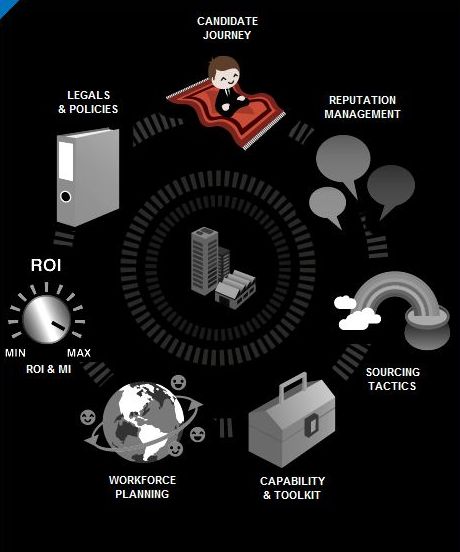
CANDIDATE JOURNEY
Intimate & Personalised v adhoc one size fits all
Where candidates are treated as consumers and where each of the 20 key touch-points in the recruitment process engage with the candidates and reflect the true culture of the organisation (avoiding the 3 month valley of death where new employees decide at month 3 whether they stay or go).
Where candidates receive the same level of service, attention and information as consumers do and the whole process is ‘user-centered’ versus ‘corporate-centered’.
Where human interaction is as important as swift automated processes.
Think:
What about the people you don’t hire, what are they saying about you?
Does your candidate journey reflect your customer experience?
Does your talent pool really understand your culture?
REPUTATION MANAGEMENT
Dialogue v Monologue
The organisation’s reputation in the market place, its employer brand and employee value proposition.
What are people saying about you as an employer?
How is this managed and communicated?
What is your social media strategy?
Is your employer brand a true reflection of reality inside the organisation?
How can you link the candidate journey to your employer brand?
Transparency and access to information means that anyone, anywhere, at any time can find out what it is like to work for you – a challenge or an opportunity?
Think:
Rather than trying to control what people are saying about you, how can you embrace social media and provide platforms for everyone to collaborate on real business challenges?
SOURCING TACTICS
Segmented & Multi-Channeled v PSL –driven
Where jobs aren’t simply given to recruitment agencies, posted on the Internet or appearing in the press.
Where the organisations ability to attract talent comes from multiple mediums, using a variety of tones, styles and conversations based on audience and skills segmentation.
One size doesn’t fit all.
Where sourcing is linked closely with communications and marketing – Becoming a talent magnet.
Goodbye traditional CV, hello interactive profiling.
Think:
How utterly fantastic was ‘The Best Job in the World’ campaign?
A true demonstration of collaboration between marketing, communications and HR, taking recruitment to totally new heights.
CAPABILITY & TOOLKIT
Enabler v Barrier
Linking People, Process and Technology.
Where people within the organisation, and any appropriate external suppliers have the knowledge, training and skills to spot, select and hire the best talent.
Where processes are simple, effective, swift and ‘user-centered’ – making it easier for everyone to recruit – not a barrier.
Where technology aids the process, doesn’t dictate it.
Where systems enable and facilitate human interaction while providing strong metrics and MI.
Think:
When was the last time your hiring managers were trained on modern recruitment practices? The way candidates now manage their career search has changed beyond recognition, do your people have the ability to exploit these new practices?
WORKFORCE PLANNING
Strategy v Box-Ticking
Where the CEO is the Chief Talent Officer and works with key people to determine the ability to match supply and demand for talent to business strategy.
Where proactive talent pools can be rapidly deployed based on scenario planning, and reactive, knee-jerk resourcing is a thing of the past.
Where every ‘internal candidate’ takes personal responsibility for managing their career.
Think:
Many organisations have a talent management system but are they being used to plan for real business needs or as a HR reporting tool?
ROI & MI
Knowledge v Information
Where return on investment is viewed from both the organisation and talent perspective. Measurement should be relevant and useful and be driven by the business for the business, data is supplied to supports the assessment and continuously measure the relevance and success of resourcing strategy and tactics.
For example, most companies measure time to hire and cost per hire, the important measure is quality of hire, what measures are in place to measure the quality of hire through PDP appraisals etc and track back to source of hire?
Think:
Data is information, information understood is knowledge, acting on that knowledge is improvement.
LEGALS & POLICIES
The organisation’s resourcing regulatory framework
Certainty v Risk - In today’s legislative heavy world it has never been more important to keep on top of the ever changing minefield of employment law, diversity, ethical and sustainability issues. Not the most exciting of the 7 pillars, but absolutely imperative.
Think:
What processes and measures do you have in place to ensure that all of your employees understand the correct procedures that need to be followed throughout the lifecycle of the candidate journey through to on-boarding?
http://www.e3unlimited.com/21st-century-resourcing
Accelerator Programme
We create a platform for your people to think, to be curious, to innovate and to redesign how work gets done.
We benchmark your organisation against industry best practices and identify solutions to transform your processes, systems and structures.
Through multi-engagement, strong communication and collaboration we empower your people, from Board level to frontline, to effect change.
Introduction
Gone are the days where millions are spent with recruitment agencies.
The rise of the Internet and the consumer revolution means gone are the days when candidates are treated poorly and no one knows about it.
Gone are the days when ‘recruitment’ is the sole preserve of the HR department.
Hello 21R, a model and benchmark based on the dual approach of organisations realising that:
1. There is no War for Talent – Talent is out there, companies just need to be better at finding and recruiting it, and...
2. Talent is thinking and behaving like consumers and as such expect to be treated so in the recruitment process and in the workplace.
A fundamental aspect to 21R is that attracting and recruiting talent is the responsibility of every person within the organisation. Once this mindset is adopted and employees become proactive talent spotters – exciting conversations happen.
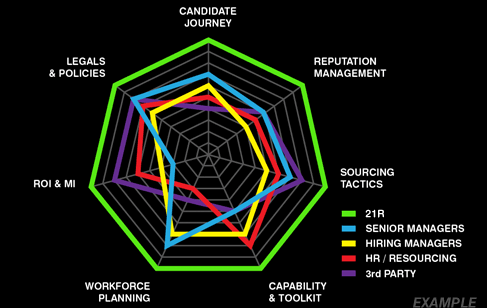
As a method of self-assessment, 21R enables organisations to focus on seven resourcing pillars as follows.
21R Methodology
21R involves various stages and levels.
The first is a
Self-Assessment Questionnaire involving a series of questions focused specifically on addressing the seven 21R pillars.
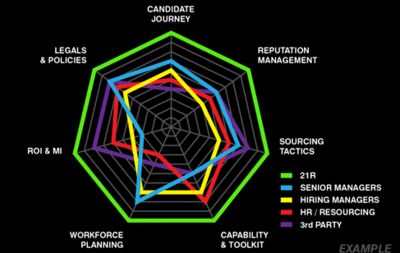
Instead of a ‘one-size fits all’ approach, the survey is pitched at three key resourcing stakeholders within organisations (i.e. Senior Management, Hiring Managers and HR/Resourcing) as well as one key external stakeholder (i.e. 3rd party suppliers).
 |
|
New World of Resourcing diagnostic results by employee sector
|
| |
All four results sets are shown separately and / or aggregated and presented as a
7 pillar radar chart, which highlights how good the organisation is at resourcing and identifies areas for improvement and development.
Following the first stage, and once the areas for improvement have been highlighted, the implementation, consultancy, benchmarking, training etc begins.
Our vision for 21R is that it becomes a continuous improvement journey where each year organisations are tested and scored to ensure they retain the accreditation of 21R.
This invaluable data will then feed into benchmark data, which can be split by industry, sector, size, etc.
http://www.e3unlimited.com/21st-century-resourcing
Social Business Design: Birth of a New Industry
New industry sectors coalesce and crystallize as a result of a number of factors converging.
In the case of
Social Business Design this is an area that has been bubbling under for about 18 months with a range of different tags, such as
Enterprise 2.0, but it never really gelled together.
There were differences of opinion on who the market was, how to approach it and what exactly did it constitute.
Was it simply setting up a corporate blog, an internal wiki and a customer forum or was there more to this area?
Charlene Li’s book
Groundswell went a long way towards gathering impetus behind this new industry sector, but still the gel wasn’t quite there.
When she left
Forrester and set up the
Altimeter Group people took notice, but their attention wasn’t galvanized.
And then
Jeremiah Oywang left
Forrester as well and joined
Charlene.
People started to sit up and really take notice – they were primed for something to happen. Around about the same time
David Armano, an exec with the
Dachis Group gave a presentation at the
Social Fresh conference titled
Social Business by Design.
The industry now had a moniker to focus around.
The key inflection point though came last week when
Dachis acquired
Headshift.
Much has already been written about this and most industry commentators will agree with the following tweet from @amayfield:
“Headshift/Dachis is massively significant. Not marketing…this is a new sector shaping up: social business.”
The Social Business Design meme is now starting to spread rapidly courtesy of one of the classic tenets of this industry: sharing.
David Armano had placed his deck of slides on
Slideshare two weeks ago. It has since been featured on Slideshare’s new “hot on Twitter” section and is gaining a lot more viewers.
This depth of attention around the topic is rapidly turning to more widespread adoption of the term, both by potential industry practitioners and by their potential clients.
An industry is born.
What is Social Business Design?
Anne McCrossan has delivered a cogent summary of this arena:
“Social business design sits at the intersection of organizational development and marketing, and can loosely be described as the practice of developing communities of engagement to develop ideas, activities and outputs for commercial and social benefit.
As organizations adopt the principles of social business design, intangible, soft assets like brand value, purpose, human resources, processes and capabilities come to the fore.
Social business design is about engendering involvement and it’s inbound.
Slightly differently, marketing services and ‘broadcast’ media operate on the basis the message and transaction are the means to the end. Marketing services communicate primarily outbound.”
Her entire post is pure gold and I highly recommend anyone who has read this far to jump over to her site and continue reading.
You will be hearing a lot more on the topic of
Social Business Design and I will aim to synthesise and analyze as much of it as I can.
Bruce Morton
September 10, 2009
http://newworldofwork.ning.com/profiles/blogs/social-business-design-birth
Emma Reynolds
Co-founder e3 Unlimited
 |
|
Emma Reynolds
|
| |
Her career started out in Australia where she was born and lived until she was 21.
At just 19 years old she joined one of the best marketing and business consultancies in Australia where she specialised in communications, organisational change and engagement. It was here that she worked on the communication strategy for the Government and also worked with Qantas and Travelex.
By age 21 she was living in Peru rebuilding devastatingly poor communities, teaching english, learning spanish and visiting homes to try and establish a safe source of drinking water.
She fell in love with the people of Peru and has since returned to the school and community to visit all she fell in love with.
On arriving in the UK in 2005 she joined Bruce at BnB and worked to build an internal engagement and external client engagement model across the 10 companies.
Together they merged and rebranded a division in Asia and it was on the return flight to London that they created the brainchild...e3 Unlimited.
In three years they have created an international brand, a generational research business Ask Gen Y and worked with some of the world's best companies.
In 2008 Emma was included on the prestigious 35 Women Under 35' list and made headlines in the Sunday Times.
Emma speaks globally about the generational and demographic challenges facing organisations and how to reinvent the way work gets done.
http://www.e3unlimited.com/emma.html
Bruce Morton
Co-founder e3 Unlimited
Bruce started out as a Butcher in the Midlands. How cool is that?
At just 21 years old he had his own shop (Bruce Morton Family Butcher) and serviced the locals for a couple of years until he broke his back. Told he may never walk again, glad to say …. they were wrong!
An inspiration to everyone who has crossed his path, Bruce cut his teeth in the resourcing and recruitment industries where he designed and implemented some of the largest resourcing solutions across many different parts of the globe During this time he has saved companies millions while securing the very best talent.
He worked with Alexander Man, TMP, and number of other large organisations before co-founding e3 Unlimited with Emma.
A sought after international speaker, Bruce has stimulated audiences across Europe, US and Asia with his fresh approach and inspiring advice in the new world of work.
Bruce has worked with Microsoft, GE, IBM, Hewlett Packard, BUPA, Barclays Bank, Sprint Telecom, Nortel, O2, Dell, Alstom, Honeywell, United Technologies Corporation, Agilent Technologies and Fujitsu.
http://www.e3unlimited.com/bruce.html



 subskrypcja RSS





















 strona: 1 z 1