Maemo brings the power of computers to mobile devices.
Designed with the internet at its core,
Linux-based Maemo software takes us into a new era of mobile computing.
Added value for Maemo users
Maemo is an advanced Linux-based operating system designed to run on high-end
Nokia mobile computers.
As this is an open-source platform, it enables the Maemo community to freely modify and continually develop software as part of a shared goal: to bring added value to all Maemo users.
Opening the box is only the beginning
Maemo is an open platform that runs on open devices. It has
Linux at its core, but Maemo also has plenty of other software components maintained by communities of open-source developers.
The platform is based on well-known technologies that are widely used in the
free software community.
Best of all, you can benefit from the work done by other developers as soon as you take your
Maemo device out of the box.
Be part of something bigger
The principle guiding the development of Maemo is that it will always remain a truly collaborative effort. Maemo was not simply created by a small group of Nokia engineers. Instead it has required the creative talents of the wider developer community over many years.
 |
|
The Maemo Community
|
| |
The Maemo creative team is bigger than you might think:
over 19,000 members working on more than 800 projects. And this number is growing all the time.
In the future, the aim is to make maemo.org a creative hub that enables users, developers, and designers to openly collaborate on all things Maemo.
http://maemo.nokia.com/maemo/
Introduction to open source
 |
|
Quim Qil, Open Source Advocate
Nokia, Maemo Devices
|
| |
“You might become more excited and involved than you intended. Your community karma might rise beyond your expectations.”
Quim Qil, Open Source Advocate
Nokia, Maemo Devices
What is Maemo?
Maemo is a Linux-based software platform consisting primarily of open source code. Maemo is designed for high-performance touch-screen devices.
Maemo Development
Maemo is developed as an open collaboration between Nokia and many generous volunteer programmers, designers, and users.
Most of Maemo's components are open source, which gives users and developers the freedom and flexibility to contribute to and modify the platform's core development.
Developers are naturally inquisitive and enjoy understanding how things are created.
Open source developers have the liberty to improve them.
As with the World Wide Web, the absence of license restrictions and fees allows anyone with the knowledge and initiative to start new projects and participate in existing ones.
The openness of the Maemo platform attracts open source projects developed by the community.
This means more choices for users and more freedom for developers.
The Maemo Community
Open source software is created by communities of developers and users working together to solve problems, innovate existing technologies, and implement new ideas. Users are in direct contact with developers and can suggest improvements, obtain support, and get involved. Smart minds, creative skills, and helpful people of all kinds are welcome – and, in fact, are necessities for a sustainable open source community.
|
|
The Maemo Community
|
| |
The best part is the exciting potential for collaboration – you will rarely find yourself working alone. This is the power of a passionate community. It’s exactly this power that brings humanity together through software that improves the lives of others.
Get Involved with Maemo
There are several ways to get involved with Maemo.
If you just want to get your feet wet in community affairs or ask other users for help, head over to
talk.maemo.org.
 |
|
Get Involved with Maemo
|
| |
If you know of a bug or want to make a feature request, do it at
bugs.maemo.org.
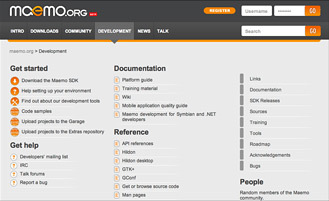
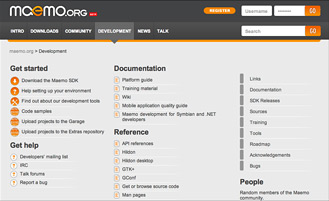
If you're a developer, start with the Maemo documentation and check out some of the current projects going on at
garage.maemo.org.
It doesn't matter how you interact with Maemo – the contribution of each member helps to improve the community as a whole.
http://maemo.nokia.com/maemo/maemo-software/
Bringing open source to the consumer mainstream
 |
Ari Jaaksi, Vice President
Nokia, Maemo Devices |
| |
“Our vision is to bring the innovation, quality, and end-user participation into the consumer mainstream.”
Ari Jaaksi, Vice President
Nokia, Maemo Devices
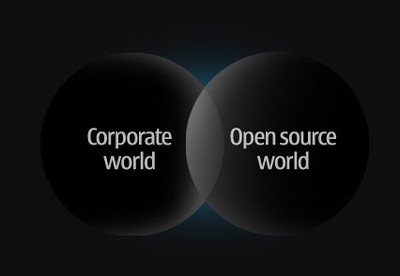
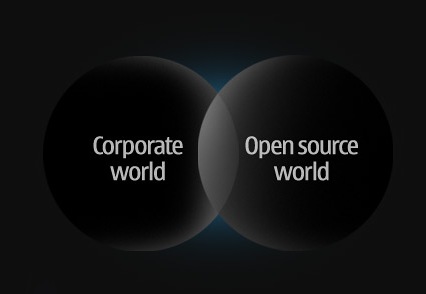
Nokia operates in two worlds
1) in a product and business world manufacturing and selling devices and services
2) in an open source world – even in a free software world – participating in many projects and peer development groups
The open source and the corporate world used to be very different. But now they overlap more and more each day.
This closeness provides very interesting opportunities, but also challenges.
 |
|
Nokia operates in two worlds
|
| |
Our vision is to bring the innovation, quality, and end user participation into the consumer mainstream.
Our vision is a fruitful and beneficial collaboration.
Maemo
Maemo.org is an open source project, sponsored and contributed by Nokia.
It’s both for the application developers and for the platform developers providing a means to work together.
Nokia uses
maemo.org as the foundation of its own
Maemo software that currently fuels Nokia’s Internet Tablets, such as
N800 and
N810, as well as the
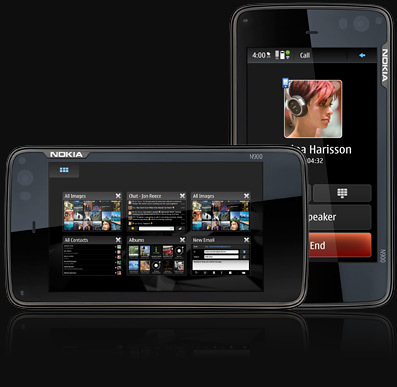
Nokia N900 mobile computer.
Maemo is the first mobile project that takes the Linux desktop paradigm to mobile devices.
I’d claim that Nokia essentially created the
Mobile Internet Devices (MID) category with the
Nokia 770.
It included several internet-centric applications, such as the desktop browser and
VoIP and
IM services, which is in contrast to
PDAs or phone-centric applications, such as
PIM or telephony apps.
It was based on
GNOME and
Linux, and from the very beginning it was all about touch screens.
A preview of the 5th Release
Maemo has evolved over the years and has certainly come a long way since the first software release. It has powered several multimedia computers, such as the
Nokia N810.
But now it’s time to introduce some of the many features of
Maemo 5.
The 5th release includes cellular connectivity for the
High Speed Packet Access (HSPA) data.
Maemo already supports
WLAN, Bluetooth and
WIMAX.
With
HSPA we can now build use cases for wireless broadband anywhere.
 |
|
A preview of the 5th Release
|
| |
Maemo will enable more computing power by running on
OMAP3 processors.
OMAP3 enables computer-like performance and advanced entertainment capabilities.
It’s based on the
ARM® Cortex – A8 superscalar microprocessor core.
The Maemo platform also includes support for high-definition
camera sensors.
This enables new multimedia use cases such as instant photo tagging and sharing.
And as before,
Maemo 5 is designed for multimedia computers that are optimised for the internet.
Software Developed with the Community
The maemo.org community is the open-source community that innovates on top and within the Maemo platform.
We invite innovation not only on top of the platform but also into the platform as an experimental lab for future innovations.
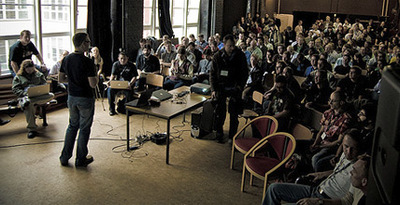
The Maemo community has over 19,000 members today and works on over 800 projects.
It’s probably the biggest open-source community for
mobile Linux.
 |
|
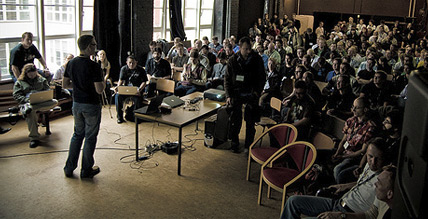
Maemo Summit 2008, Berlin, Germany
Photo: Nokia
|
| |
Nokia also contributes to many other upstream open-source projects such as
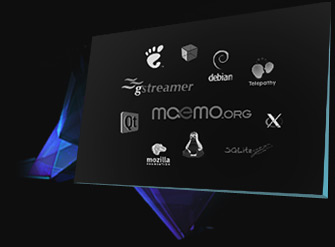
GNOME/GTK+, Linux kernel, Debian, Gstreamer, Telepathy, etc.
Nokia is proud to work in close collaboration with developer communities and is committed to supporting open-source projects now and in the future.
http://maemo.nokia.com/maemo/open-source/
Pushing the boundaries of UI design
 |
|
Jussi Maaniitty, UI Project Manager
Nokia, Maemo Devices
|
| |
“Earlier products have been technological playgrounds where we have tried to perfect touch solutions – we can say we have now reached that point.”
Jussi Maaniitty, UI Project Manager
Nokia, Maemo Devices
Let’s think for a moment what would be the ideal mobile device.
I’m sure it would fulfill a social need such as keeping in touch with friends, family, or social groups.
It should provide access to the content you value, in ways that you’ve already become accustomed to – and without unnecessary, disturbing UI elements. It should help you reach your destination, wherever that is. And you should have all this at your fingertips.
 |
|
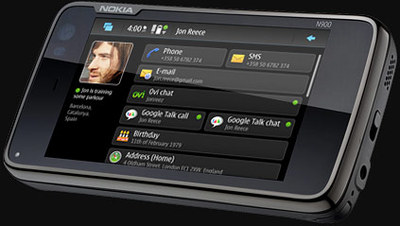
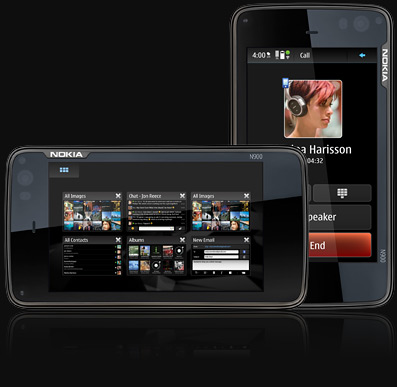
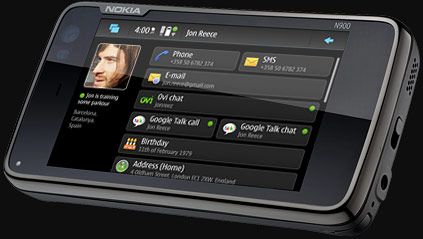
Maemo is available on the Nokia N900 - a high-performance mobile computer with a powerful processor, large internal storage, and sharp touch-screen display.
|
| |
That was our initial goal, and it has stayed with us throughout the entire development process of the
Maemo 5 UI.
I’ll explain here in more detail our thinking behind this.
Staying in control with just a touch
We’ll start the game by looking at our
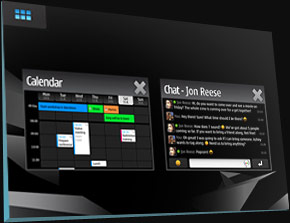
Dashboard with Calendar and Conversations running.
You’ll notice there’s a thumbnail of a running application, there’s a cross to close that application, there’s a plus sign to add something, and the desktop is also visible in the background. And this is the navigation system.
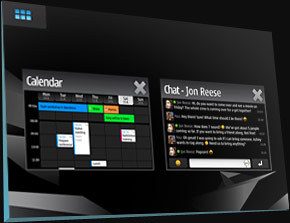 |
| Calendar and Conversations running |
| |
All these elements react to a touch of the screen and take you exactly where you expect.
An interface based on touch allows us to build a framework that’s not visible, and yet at the same time is still obvious.
Pointing your finger to a place where you want to go takes you there immediately and directly – without double taps or long presses.
Experiencing the mobile internet in a new way
You can browse the internet pages you’re used to without making compromises.
Normally with mobile devices you need some time to adjust to a new way of browsing the internet. Also, the pages you use on a personal computer often don’t work on a mobile handset.
This means that the gap between the two may prevent you from accessing the information and services you need while on the go.
For us, this was not acceptable.
Pages shouldn’t have to be modified for mobile devices.
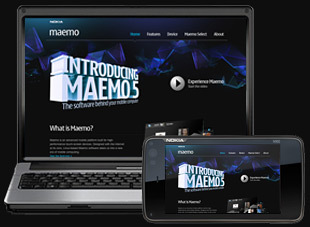
What you see on your personal computer you can see on the
Nokia N900.
 |
|
mobile internet
|
| |
This is our heritage that we carry proudly from our
Internet Tablets to our
new mobile handsets.
The other supporting design principle is that you’re always connected, without questions.
The internet is integrated into our system, meaning it’s present in your social environment all the time.
Always online. Always in touch.
http://maemo.nokia.com/maemo/interface-design/
http://maemo.nokia.com/



 subskrypcja RSS






















 strona: 1 z 1