DESCRIPTION OF BOOK
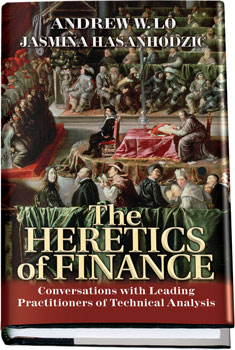
The Heretics of Finance provides extraordinary insight into both the art of technical analysis and the character of the successful trader. Distinguished MIT
professor Andrew W. Lo and
researcher Jasmina Hasahodzic interviewed thirteen highly successful, award-winning market professionals who credit their substantial achievements to technical analysis. The result is the story of technical analysis in the words of the people who know it best; the lively and candid interviews with these gurus of technical analysis.
The first half of the book focuses on the technicians' careers:
--How and why they learned technical analysis
--What market conditions increase their chances of making mistakes
--What their average workday is like
--To what extent trading controls their lives
--Whether they work on their own or with a team
--How their style of technical analysis is unique
The second half concentrates on technical analysis and addresses questions such as these:
--Did the lack of validation by academics ever cause you to doubt technical analysis?
--Can technical analysis be applied to other disciplines?
--How do you prove the validity of the method?
--How has computer software influenced the craft?
--What is the role of luck in technical analysis?
--Are there laws that underlie market action?
--What traits characterize a highly successful trader?
--How do you test patterns before you start using them with real money?
Interviewees include:
Ralph J. Acampora, Laszlo Birinyi, Walter Deemer, Paul Desmond, Gail Dudack, Robert J. Farrell, Ian McAvity, John Murphy, Robert Prechter, Linda Raschke, Alan R. Shaw, Anthony Tabell, Stan Weinstein
AUTHOR
Andrew W. Lo is the Harris & Harris Group Professor of Finance at the MIT Sloan School of Management and the director of MIT’s Laboratory for Financial Engineering. His previous books include The Econometrics of Financial Markets, A Non-Random Walk Down Wall Street, and Hedge Funds: An Analytic Perspective. He is also the founder and chief scientific officer of AlphaSimplex Group, LLC, a quantitative investment management company based in Cambridge, Massachusetts.
Jasmina Hasanhodzic is a research scientist at AlphaSimplex Group, LLC, where she develops quantitative investment strategies and benchmarks, including the CS 130/30 Index. She received her PhD from MIT’s Department of Electrical Engineering and Computer Science, where she proposed new methods for automating technical analysis and replicating hedge fund betas. Her work has appeared in the Journal Of Investment Management and Institutional Investor’s Alpha magazine. A summa cum laude graduate of Yale College, Hasanhodzic is a recipient of a number of awards for academic excellence and a member of several honor societies, such as Sigma Xi, the Scientific Research Society.
QUOTES AND PRAISE
“Technical trading is ubiquitous in financial markets, which might explain some major financial-market anomalies and makes it an important topic for research. Like good scientists, Lo and Hasanhodzic explore this territory by gathering first-hand observations, with fascinating results.”
—
Carol Osler
Program Director, Lemberg Masters in International Economics and Finance
Brandeis International Business School, Brandeis University
“The Heretics of Finance is a fascinating view of the art and craft of technical analysis. For finance professionals and academics alike, this book is an excellent introduction to what technical analysts do and why it may make sense in modern markets. An enjoyable and very enlightening book.”
—
Maureen O’Hara
Robert W. Purcell Professor of Finance
The Johnson School, Cornell University
“In the last twenty years, academics have piled up evidence on the puzzling success of technical analysis, yet few researchers are very familiar with the thinking of technicians. Lo’s and Hasanhodzic’s interviews with well-known technicians illuminate their thinking on the markets and their profession. The Heretics of Finance is a must-read for economists studying technical analysis, behavioral finance, or related market anomalies. I recommend it highly.”
—
Christopher J. Neely, PhD
Assistant Vice President, Federal Reserve Bank of St. Louis
TABLE OF CONTENTS
Preface
Acknowledgments
Introduction
1 Ralph J. Acampora
2 Laszlo Birinyi
3 Walter Deemer
4 Paul Desmond
5 Gail Dudack
6 Robert J. Farrell
7 Ian McAvity
8 John Murphy
9 Robert Prechter
10 Linda Raschke
11 Alan R. Shaw
12 Anthony Tabell
13 Stan Weinstein
14 Conviction: Countering the Skeptics and the Scoundrels
--The validity of technical analysis
--Acceptance by academics
--Sustaining confidence while sustaining losses
--Literature versus experience
--Hard and fast rules and proven theories
--Wider applications for technical analysis
--Proving the validity of technical analysis
15 The Evolution of Technical Analysis
--Evolution of the craft
--New indicators and patterns
--Computer software and the craft
--Computer-generated signals
--Hand-drawn charts
16 Luck, Astrology, and Other Unsanctioned Signs
--The role of luck in technical analysis
--Astrology and the credibility of the craft
--Elliott wave, Gann’s postulates, and Fibonacci numbers
17 Creativity, Talent, and the Art of the Craft
--The Role of Creativity
--A talent for technical analysis
--Personality traits of the highly successful
--Hard work and dedication
--Analysis as art
18 The Challenge of Emotions
--Losing money
--Emotional interference
--Separating emotions from the work
19 The Path to Success
--Artificial intelligence
--The key to success
20 Favorite Patterns and Indicators
--Most and least reliable indicator
--Testing
--The effect of market conditions
--Indicative versus descript
References
Index
EXCERPT
Chapter 1
Ralph J. Acampora
“When you’re practicing technical analysis, you have to be totally eclectic, because there will be a time when the approach you’re using doesn’t work. If you’re not flexible, you’ll self-destruct.”
With forty years of experience, Ralph J. Acampora has been instrumental in the development of modern-day technical analysis. He is the New York Institute of Finance’s (NYIF) director of technical analysis studies and has taught at the institute for thirty-seven years.
Before joining NYIF, he was director of technical research at Knight Equity Markets and worked for fifteen years at Prudential Equity Groups as its director of technical analysis.
His career has included positions at several of the financial industry’s top firms, including Kidder Peabody and Smith Barney. One of Wall Street’s most respected technical analysts, Acampora is regularly consulted for his market opinion by major business news networks as well as national financial publications, and he has been consistently ranked by Institutional Investor for more than ten years. He is a chartered market technician (CMT), a designation he helped create and which is now recognized by the National Association of Securities Dealers as the equivalent of a chartered financial analyst (CFA).
Acampora cofounded the Market Technicians Association (MTA) in 1970, is a past president of that group, and continues to be an active member of the society. He also founded and was the first chairman of the International Federation of Technical Analysts (IFTA), comprising more than four thousand colleagues around the world. As an educator, Acampora also participates in the Security Industry Association’s annual Wharton seminars.
Acampora is a trustee on the Board of the Security Industry Institute (SII) and is involved in the establishment of the Securities Traders Association University (STAU).
He is the coauthor of the CMT examination and the author of the book The Fourth Mega-Market, Now Through 2011: How Three Earlier Bull Markets Explain the Present and Predict the Future.
What led to your interest in technical analysis?
I came to Wall Street in 1966 after a couple of years in a Catholic seminary. My educational background is in history and political science, and I worked on a master’s degree in theology, so I had absolutely no background in this business. I had a major spinal fusion operation, which ended my theology studies. My father’s best friend was William Downe, who was a specialist on the floor of the New York Stock Exchange, with a firm called Spear, Leads Kellogg. Bill Downe was able to get me a very fine back surgeon.
Every day Mr. Downe would come to the hospital and visit with me, and he’d have publications like the Wall Street Journal, Forbes magazine, Barron’s. I was in a body cast for three months, so I was like a little inverted turtle.
Downe would throw everything he was reading on the bed. I was a captive, so for three months I read all this stuff about Wall Street.
When they took the cast off, I told him I was not going back into the seminary, and he asked me what I wanted to do with my life. I told him I enjoyed reading the stuff he had given me. “That’s research,” he said.
That was in the mid-’60s, and research was in its very formative stages in those days. Mr. Downe introduced me to Bill Grant at Smith Barney, which was probably one of the first brokerage firms to create what we know today as modern fundamental research.
Grant told me to get an MBA, come back, and he’d give me a job. But I had had many, many years of schooling. I was twenty-seven years old. I didn’t want to go back to school. That frustrated Mr. Downe because he couldn’t help me. I didn’t have the fundamental background for research. I was still on crutches, and I literally hobbled around Wall Street. I went from job interview to job interview. After a while, I realized I wanted to be an analyst.
Finally, I interviewed at a firm called Distributors Group, which was a small mutual fund, and they hired me. My working day was split in half. The first half was devoted to maintaining a point-and-figure chart library of over two thousand charts that I did by hand. The second half was devoted to calculating price-to-earnings ratios for companies our firm had an interest in. I was spending half of my life doing technical analysis and the other half doing fundamental analysis. These people were so kind and wonderful that they kept pushing me, and I apparently excelled at technical analysis.
The man who started this mutual fund at Distributors Group was Harold X. Schreder, who had been an economic adviser to President Eisenhower.
Mr. Schreder ran a very successful business and he insisted that every portfolio manager plot the stocks they owned in their respective portfolios. Every Thursday we would meet, and portfolio managers would stand with charts of the stocks that they owned in their portfolios. If anything looked suspicious on a chart, people would whistle, make noises, and say, “Hey, how can you own that ugly thing?”
That was discipline.
That was my first introduction to technical analysis. It was in the late ’60s.
By 1968 they sent me to the New York Institute of Finance, so that one day I might become a portfolio manager. The New York Institute of Finance is a school of Wall Street, and I took a series of classes. One of the classes was taught by Alan Shaw. Alan became my mentor and dear friend. We started working together in October 1969. I can’t begin to tell you how much Alan taught me. Around 1970, Alan was to have lunch with a man named John Greeley. John was also running a technical department, and he had a young fellow with him by the name of John Brooks. Alan couldn’t make the lunch, so he sent me. At that luncheon Brooks and I asked each other, “Who do you know in technical analysis?”
I told him about Alan Shaw, and he knew a fellow by the name of Bob Farrell at Merrill Lynch. Those were important names, and that was the beginning of the Market Technicians Association. It was actually John Brooks and I, with a little help from Greeley, who started it. In those days the only place Wall Street analysts met corporate America was at the New York Society of Security Analysts.
Getting a ticket to go to a luncheon to listen to the chairman of General Motors was virtually impossible for junior analysts like us. All of the fundamental analysts had their own little groups—the chemical analysts met, the drug analysts met, and the oil analysts met—to share their ideas.
Technicians never met because we never had a formal group. So we wanted to unite the technicians of Wall Street. Of course, we went back to our old mentor friends—John Greeley and Alan Shaw—to get advice. We were able to get help from Bob Farrell, as well.
While working at Harris Upham with Alan, I also met a man by the name of Ralph Rotnem, who was Alan’s mentor. In the history of technical analysis, the great names are Edson Gould, Ralph Rotnem, Ken Warden, Edmund Tabell, Tony Tabell, and John Schultz.
The mission and the goal of the MTA was and is today to educate ourselves and the public about the true meaning of technical analysis. People think that the MTA started in 1973. It officially started in 1970, but it was incorporated in 1973.
Our first president was Robert Farrell of Merrill Lynch.
Alan Shaw was our second president. These people were very well known in their circles.
I eventually started teaching technical analysis at the New York Institute of Finance, where I’ve been teaching it for over three decades.
Which mistake taught you the most?
It was trying to make more of technical analysis than it is. The biggest mistake people make is to overburden themselves with indicators.
The simpler you keep it, the better it is. In my early days, I was trying to do too many things with the subject, but we didn’t have that many indicators anyway. Now, with the advent of the computer, they’re back-testing everything and trying to reinvent the wheel, and I don’t think you have to do all that. Keep it simple. I interviewed Richard Russell, who is the living guru of Charles Dow, and I asked him what advice he’d offer the younger generation of technicians. He said, “Always follow the major trend.” If you understand the major trend in the market, then everything will fall into place. I agree with that.
Describe your style of technical analysis.
I’ve been in the business for almost forty years. I think the biggest thing I bring to the table—and that’s probably what distinguishes my style—is history.
I was a history major in college, and I love it. A few reports that I have been successful in writing basically reconstructed historic events; I then applied the historic events to the current market. It worked. That’s what technical analysis is; it’s history.
In what kind of market conditions do you make the most mistakes?
In a trending market, I believe, things are easier. In a nontrending market, which is by definition much more volatile, the odds of making mistakes increase.
For example, moving averages are very helpful in trending markets.
They keep you in a direct path. However, don’t ever use moving averages in trendless markets, or at least be very careful when using them there, because you’ll get whipsawed. But once you identify a nontrending market, there are certain things you do and certain things you don’t do. For example, you don’t use moving averages extensively.
When do you use your indicator and when don’t you use your indicator?
That answer comes only with experience, after many years of trial and error.
How much of what you do are you willing to share with others?
I have spent my whole life teaching. I share everything.
If all patterns/indicators/strategies you use are in the public domain, what is it about the way you use these tools that accounts for your superior success?
I don’t know about superior success, but I’ve been in business for a long time, so I must be doing something right. In investing (or trading), you have to be honest with yourself and you have to be flexible.
We all make mistakes, but we must not compound our mistakes.
In technical analysis, you can correct the mistakes quickly, but you have to have the ability to admit a mistake. People will respect you for doing so.
When you’re practicing technical analysis, you have to be totally eclectic, because there will be a time when the approach you’re using doesn’t work. If you’re not flexible, you’ll self-destruct. I don’t believe that any one approach works all the time. When in doubt, always default to price.
People debate: “Oh, I’m a volume guy,” or “I’m a put-call-ratio guy.” You don’t own volume, you don’t own put-call ratio—you own price!
That’s my dictum.
If a trend is going up—I don’t care if it’s going up on light volume—I am with it.
If it’s going down, I am with it. I own the price. Not everybody will do that.
How do you deal with the problem of the tradeoff between early signal detection and sensitivity to random noise?
First of all, if you’re a short-term trader—and I’m talking about day to day or couple of weeks to couple of weeks, which is not what I do—you’re more susceptible to random noise.
All the firms I worked for—and I worked for three major brokerage firms—invariably told us to have a twelve-to-eighteen-month time horizon, just like the fundamental analysts did.
So I don’t pay attention to little jiggles and wiggles.
However, being human and having to call market turns, I get fouled up by an erratic move or two, which can distort things. But if you eliminate a lot of noise, it shouldn’t impede or interrupt your long-term outlook. I just don’t do short-term trading.
I don’t want to do it, though if I had to, I could, and then I would have to deal with the noise. There will always be noise there.
That’s why you use stop-losses to protect yourself.
Is technical analysis more effective when used on its own or when combined with fundamental analysis?
If I were in charge of a portfolio or a mutual fund, I would always start with fundamentals. There would have to be a reason why I want to own a company, but technical analysis would always dictate when and how I would deal with a stock.
So under those circumstances, I would want to have both. Now, when you step into my chart room, you’re asking me my opinion, which is one hundred percent technical.
When we put out a market letter, it’s a technical market letter. It’s not dictated by any other outside forces except the technical ones.
When I go on the road and I’m talking to a large audience, and especially when I’m talking to the public, I try to set up a fundamental case to back my picture, because it’s easier to present a position that way.
I can’t just say, “Well, you’ve got to buy this stock; it has a nice bottom.”
That doesn’t sell it. I could say that to a professional technical audience, because they would understand that. But for an audience that’s not technically sophisticated, you have to gauge your terms.
That’s where the problem with technical analysis lies: It’s not with what we do; it’s with how we say it.
We confuse people with our jargon, so I don’t use that language.
I use words like overvalued and undervalued instead of tops and bottoms. A base is a stock that is undervalued, and a top is a stock that is overvalued.
Believe me, fundamentalists understand exactly what that is.
So your approach is purely technical. You bring in fundamental analysis only when you’re explaining your purely technical approach to a nontechnical audience. Correct?
Yes. At Prudential, I created a unique product. It starts with the universe of fundamental stocks that the firm follows. Out of those stocks, I’ll take only the ones that are graded as buys.
Then I’ll ask, “Of these fundamental buys, how many are quantitatively graded positive or negative?”
I take that list of fundamental buys, and I run it through the quant screen.
Let’s say starting out with five hundred stocks, two hundred are fundamentally attractive.
One hundred of them are positive quantitatively. I’ll take that one hundred, and I’ll look at them technically. Maybe seventy-five of the one hundred will look good technically. These stocks now have gone through a triple screen, so I call them “trice blessed”—from fundamental, quantitative, and technical points of view. We do that report once a month. We also have fundamental analysts who have sell ideas. Stocks graded as sells are “cursed.” They may be “twice cursed” or “trice cursed”; that is, they can be cursed from a fundamental, quantitative, and/or technical point of view.
Clients love this system because they understand that I’m using all three of the disciplines. Although I’m a technician, I use the other two disciplines before I get to the technical recommendations.
So I use other research disciplines, and it’s a very popular product.
Does political or global analysis influence the decisions you make in your chart room?
I have the TV on all the time. I read many newspapers and magazines. I try to follow what’s going on in the real world. We can’t live in a complete vacuum.
Does the news change my market opinion? No, my market opinion is technical.
Can it have an impact? Oh, sure. Things like presidential cycles certainly can have an impact. We did a whole study on the impact of wars on the markets. When wars start, the market usually goes up.
People don’t believe that. That’s all history, and it’s fun.
I think technicians make better fundamentalists. You do it backwards, because when you see something on a chart, you’ve got to find out why.
A good technician is always asking why.
Why do you eventually share your inventions with others, rather than keeping the edge for yourself?
I don’t explain everything in detail. I explain what I’m trying to do, but I don’t give out the formula. The formula is proprietary, and I tell people it’s a proprietary indicator. It makes it a little mysterious, too. It’s not all that complicated.
I do fairly basic technical analysis. Up is good; down is bad. Seriously.
I know it’s hard for some to believe that, but it’s true. The trend is most important.
People tend to make more out of the subject than it really is. Keep it simple.
How often do you use the technical tools you developed yourself?
As frequently as possible. They’re not trading tools. I might use a particular formula a couple of times a month for a report.
My work doesn’t depend on a computer program. If computers all disappeared tomorrow, I’d still be the same technician I am today.
Describe your working day.
I get into the office around seven o’clock in the morning and leave about six. I live nearby. By the time I get there, I’ve already read theWall Street Journal and watched the news on television, all in order to get a feel for what the day might hold in store.
By the time I walk into this building, I think I know exactly what the market is going to do. Everything seems perfect. But the problem is, when I get in the elevator, I talk to a few people, and by the time I get off the elevator, I am totally confused because I have to deal with the real world.
Right across the hall is the conference room, where I listen to the fundamental analysts at 7:30 a.m. They talk about different industries, and I take notes. I accept everything the analysts say, but when I step into our chart room and close that door, I don’t listen to the fundamentals anymore. I’m religious with my graphs. I wouldn’t buy anything that’s going down, despite what the analysts say.
Moreover, I talk with clients and write all the time.
Monday, when I do a considerable amount of writing and have two to three conference calls, is the worst day of the week.
Traders call here as well, and that’s a minute-by-minute application of charting.
The two other technicians are always discussing indicators, market reactions, etc.
The ideas are constantly being brought out. At times, the room is quiet as a library because we’re in the research department, and we need time to think.
The Heretics of Finance
Conversations with Leading Practitioners of Technical Analysis
Andrew W. Lo
Jasmina Hasanhodzic
The story of technical analysis from those who know it best
Format: Hardcover
ISBN: 9781576603161
Publisher: Bloomberg Press
Pub. Date: 1/2009
288 pages, 6-1/8" x 9-1/4"
Retail Price: $29.95



 subskrypcja RSS




















 strona: 1 z 1