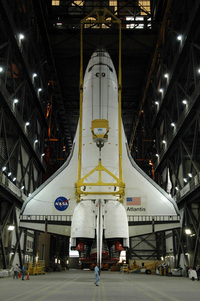
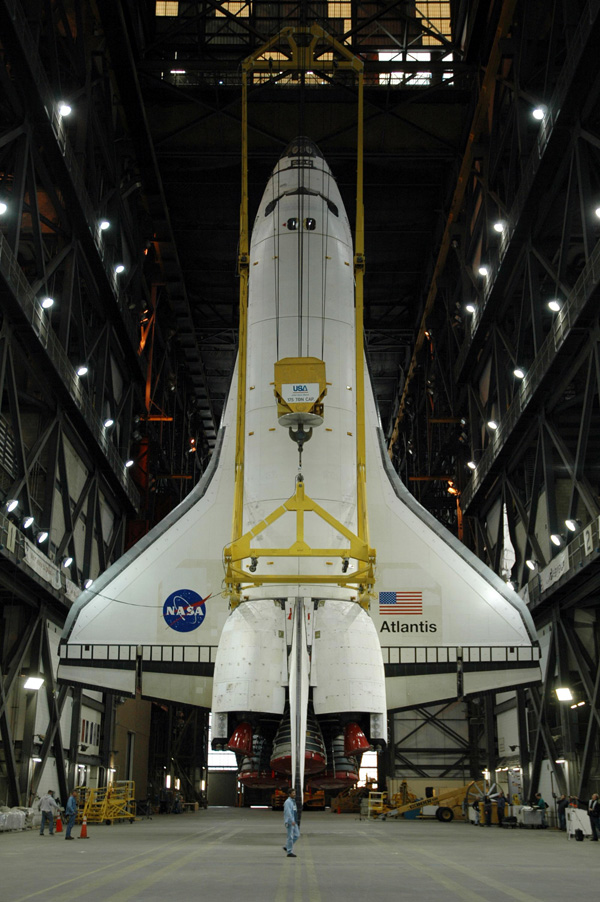
Space Shuttle Atlantis hangs suspended in its sling in the transfer aisle of the Vehicle Assembly Building. Preparations are underway to lift the vehicle up into high bay 1, where it will be lowered onto the mobile launcher platform for mating to the external tank and solid rocket boosters.
| |
 |
| |
Atlantis is suspended vertically in the Vehicle Assembly Building.
Photo credit: NASA/Amanda Diller |
| |
The orbiter was transported to the Vehicle Assembly Building on Wednesday. First motion was at 6:19 a.m. EST.
The rollover marks a milestone in the start of the vehicle's journey to Launch Pad 39A, scheduled for Feb. 14. Mission STS-117 will be the first launch at Pad 39A in four years.
The flight of Space Shuttle Atlantis to the International Space Station on mission STS-117 has been targeted for March 15, a day earlier than originally planned.
On the next space shuttle flight to continue constructing the station, the Atlantis crew will install a new truss segment, retract a set of solar arrays and unfold a new set on the starboard side of the station. Lessons learned from two previous missions will provide the astronauts with new techniques and tools to perform their duties.
Commanding the Atlantis team is Frederick Sturckow, a veteran of two shuttle missions (STS-88, STS-105), while Lee Archambault will be making his first flight as the shuttle's pilot. Mission Specialists James Reilly (STS-89, STS-104) and Patrick Forrester (STS-105) will be returning to the station. Steven Swanson and John Olivas, both mission specialists, join the crew for their first flight into space.
The mission astronauts will return to Kennedy a few weeks before liftoff to participate in the Terminal Countdown Demonstration Test. During this time they will practice launch activities, safety exercises, inspect the payload and conclude with a simulated main engine cut-off exercise.
STS-117 Mission
| |
 |
| |
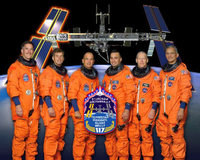
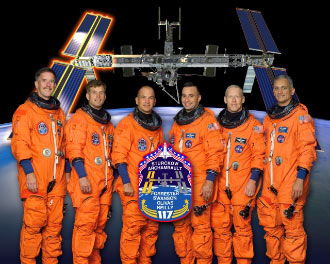
Image above: The crew of STS-117 pose for their official portrait.
From left are mission specialists James Reilly II and Steven Swanson, Commander Frederick Sturckow, Pilot Lee Archambault and mission specialists Patrick Forrester and John D. Olivas.
Image credit: NASA |
| |
Frederick Sturckow, a Marine colonel, will command STS-117. The mission will deliver the second and third starboard truss segments (S3/S4) and another pair of solar arrays to the space station.
Pilot Lee Archambault, an Air Force colonel, joins Sturckow in the Shuttle’s cockpit. Mission specialists James Reilly II, Ph.D., Patrick Forrester, Steven Swanson, Ph.D., and John D. Olivas, Ph.D., round out the crew.
STS-117 is the 21st shuttle mission to the International Space Station.
STS-117: Just Do It - Again
If you missed either of the last two missions, now would be the time to catch up.
When Atlantis heads for the International Space Station in March, its mission may sound a little familiar. The crew will install a new truss segment, unfurl new solar arrays and fold up an old one – all tricky stuff that’s been done on the past two missions.
| |
 |
| |
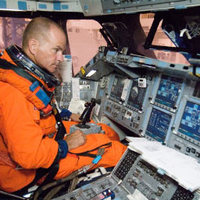
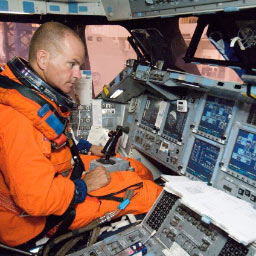
STS-117 Commander Rick Sturckow trains in a mockup of the space shuttle cockpit at Johnson Space Center.
Credit: NASA |
| |
“I jokingly call those flights the test flights for us,” said Kelly Beck, lead space station flight director for STS-117.
And with two successful missions leading the way, those involved with this flight are hoping it will be the best yet.
“We’re really fortunate that we have those guys to follow,” Atlantis’ commander, Rick Sturckow, said. “Almost everything went great on those missions, and the things that didn’t go so well, we’re able to learn from.”
The new set of solar arrays that Sturckow’s crew – Pilot Lee Archambault and mission specialists Patrick Forrester, Steven Swanson, John "Danny" Olivas and Jim Reilly -- will install on the starboard side of the station will be a mirror image of those installed on the port side in September. And like the crew that installed the port arrays, the STS-117 crew will be in charge of unfolding the arrays and preparing them to track the sun and generate power. It sounds straightforward, but the first time a set of solar arrays was unfolded in space in 2000, things didn’t go quite as intended. The array panels stuck together, allowing cables meant to pull the arrays taut to come off their pulleys and leave the array slack.
The crew was able to fix the problem, but to avoid it altogether in the future the unfolding technique changed when the second set of arrays was launched on STS-115. By unfolding them more slowly and during periods when the station flew in sunlight, the arrays were deployed without a hitch – a circumstance the Atlantis crew hopes to repeat in March.
“It takes a little bit longer to deploy, but it’s done in a safer manner,” said Cathy Koerner, shuttle lead flight director. “We’ll be doing that again for 117.”
| |
 |
| |
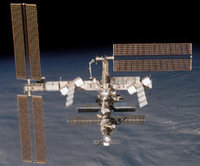
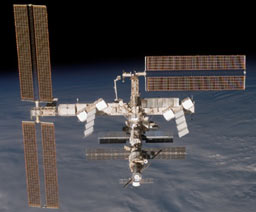
The port solar arrays are seen in the far left of this picture. STS-117 will install matching solar arrays and truss segments on the starboard side of the space station.
Credit: NASA |
| |
But the crew members also want to learn from a problem their predecessors experienced in September. A 10-foot wide rotary joint turns the solar arrays, allowing them to track the movement of the sun. But before that can happen, the bolts that keep the joint from shifting during launch in the shuttle’s cargo bay have to be removed.
That’s where the STS-115 crew ran into trouble – it turned out the bolts were screwed in more tightly than expected. It took more than 20 minutes and two astronauts to loosen one of them. So this time, Sturckow said, Swanson and Forrester, the spacewalkers who will be removing the bolts during the mission's second spacewalk, will be prepared.
“They’re working out every day,” he joked.
In case that’s not enough, however, they’ll have a tool on hand that will give their elbow grease a little more oomph.
“We have a torque multiplier that we’re bringing up that they didn’t have,” Sturckow said. “So if we do encounter the same difficulty with high torques that they had, we’ll break out this tool. And we’ll apply whatever torque it takes to break the bolt or back it out at the higher torque settings. So I don’t have any doubt that we’ll be able to remove those launch restraints.”
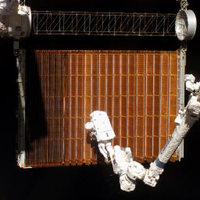
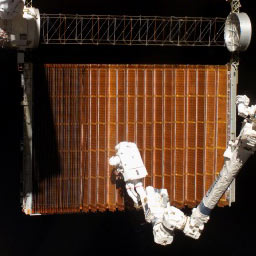
And from STS-116’s mission, Atlantis’ crew is planning to learn from the problem Discovery’s crew encountered in retracting a solar array that was circling the Earth for more than six years. Like the arrays activated in December, the new arrays won’t be able to rotate and track the sun until another set of arrays is retracted. And if STS-116 is any indication, it won’t be easy. It took more than 71 tries and an extra spacewalk to neatly fold the array back into its box during that mission.
The original plan was for the arrays to be folded by ground command while all the astronauts were inside the station. But flight controllers now are working on a plan that would have Forrester and Swanson ready to assist with the folding during the second spacewalk of the mission. And if that doesn’t do it, Reilly and Olivas could give it a try during the third spacewalk.
“I think we’re going to end up doing something totally new here,” Sturckow said.
The space station program will be looking at the data gleaned from all those attempts to retract the arrays to decide how to change the flight plan. Even with less than three months to go, Koerner said there’s still plenty of time to make modifications.
| |
 |
| |
A spacewalker on the station's robotic arm manually helps retract a solar array during STS-116. Credit: NASA |
| |
“It’s not like in the old days, where when you got within six months of flight you pretty much knew what you were doing,” she said. “When you’re doing assembly operations, everything that you plan to do is contingent on the flight prior to you and the hardware that’s already on orbit. In truth? The flight plan will be firmed up post landing when we can turn around and look at what we’ve done and feel good about the success of the mission.”
Brandi Dean
NASA's Johnson Space Center
18.01.2007
http://www.nasa.gov/mission_pages/shuttle/shuttlemissions/
sts117/mission_overview.html
|



 subskrypcja RSS



















 strona: 1 z 1